Power Without Armor: 5 Ways to Soften Without Losing Yourself

There is a specific kind of exhaustion that does not come from working too many hours.
It comes from holding yourself together all the time.
From being the steady one.
The strategic one.
The woman who does not fall apart.
The one who anticipates, calculates, solves, and absorbs.
If you are a high-achieving woman, strength likely became your currency early in life. Maybe you were the responsible child. Maybe you learned quickly that competence earned safety. Maybe life required you to grow up faster than you should have.
So you adapted.
You became capable.
You became composed.
You became impressive.
And somewhere along the way, you built armor around your power.
Armor looks like independence that borders on isolation.
Armor sounds like “I’ve got it” even when you are tired.
Armor feels like bracing before anyone can disappoint you.
And here is the part no one talks about: armor works.
It helps you build careers.
It helps you survive heartbreak.
It helps you navigate corporate rooms and complicated relationships.
But armor also limits range.
It keeps you safe from pain, yes.
But it also keeps you slightly distant from joy, desire, and deep connection.
Many strong women reach a point where everything looks stable on paper, yet something feels muted inside. You are not in crisis. You are not falling apart. You are functioning beautifully.
But you are not fully lit up either. That is the quiet signal that strength alone is no longer your next level.
Your next level is power without armor.
Softening without losing yourself is not about becoming less ambitious. It is not about abandoning boundaries or lowering standards. It is not about shrinking so someone else can feel bigger.
It is about integration.
It is about becoming a woman who can lead a boardroom and receive affection.
As a woman who can hold structure and hold emotion. A woman who can desire deeply without chasing. A woman who can feel without collapsing.
For many analytical, high-performing women, the fear of softening is this: If I lower the armor, will I lose my edge?
The truth is the opposite.
When you are no longer expending energy defending yourself from potential hurt, you free that energy for magnetism, creativity, and embodied confidence.
Softness, when paired with self-trust, is not weakness. It is mastery.
This conversation is especially important for women who have built their lives through discipline, intelligence, and resilience. You do not need to dismantle your strength. You need to evolve it.
Because the woman who can soften without losing herself does not lose authority. She gains depth. And depth is where fulfillment lives.
In this guide, we will explore five grounded, practical ways to soften without losing yourself, especially if you are used to being the strong one.
Not to undo who you are. But to expand her.
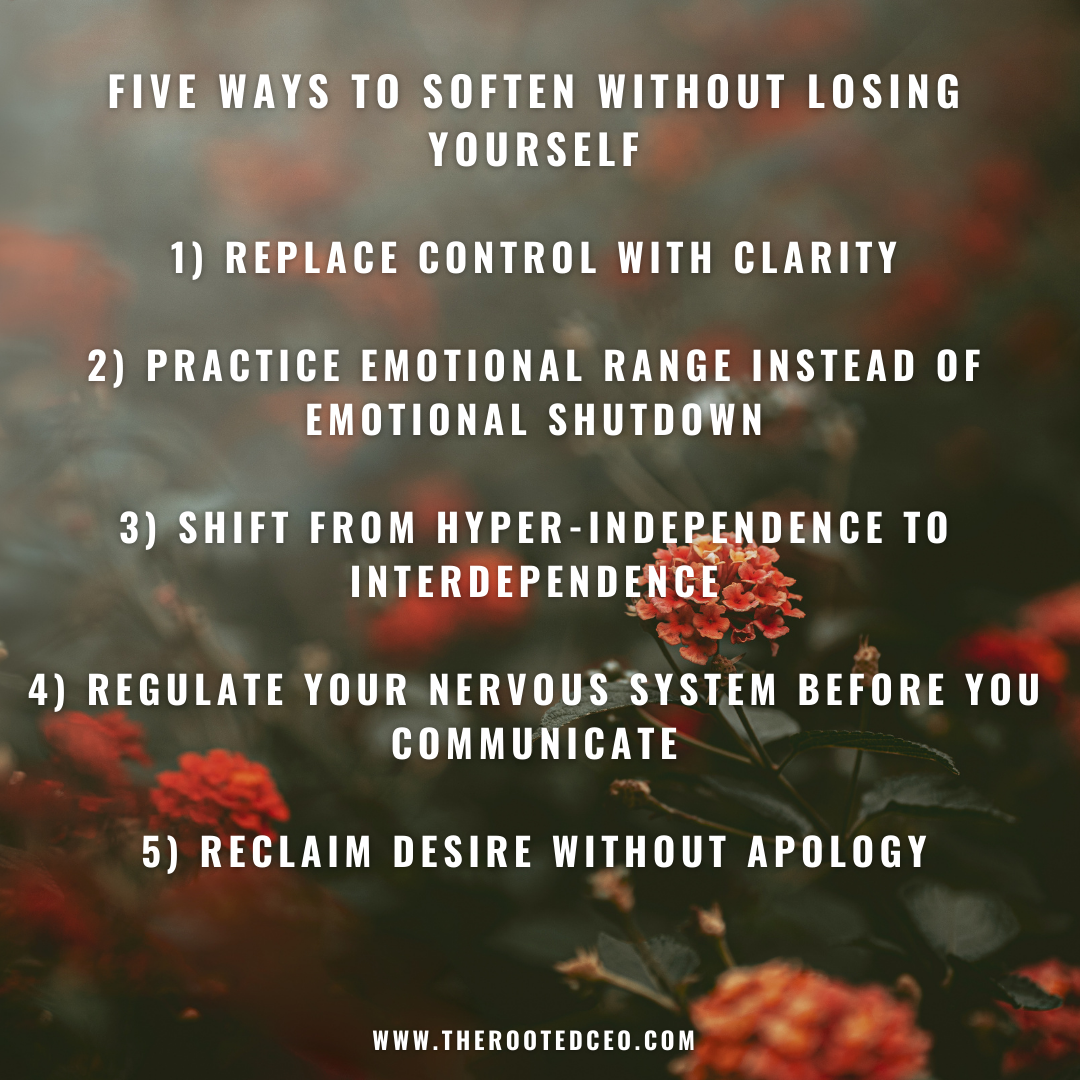
1. Replace Control With Clarity
Control often develops when unpredictability once hurt you.
If you were disappointed, abandoned, overlooked, or forced to grow up early, you likely learned that staying ahead of everything kept you safe. You began to anticipate needs. You solved problems before they formed. You managed outcomes before anyone else could mishandle them.
Over time, that level of control became your default operating system. It probably even became part of your identity.
You are efficient. You are proactive. You are the one who handles it. And in many ways, that skill set built your life.
But here is the subtle cost: constant control keeps your nervous system in a low-grade state of vigilance. You are always scanning, always assessing, always slightly braced for what could go wrong.
Softening without losing yourself begins when you realize that control and leadership are not the same thing.
Control is rooted in anxiety. Clarity is rooted in self-trust.
Clarity says:
I know what I need.
I can articulate expectations.
I can tolerate uncertainty without micromanaging every detail.
I trust myself to respond if something shifts.
Control tries to eliminate uncertainty entirely. Clarity accepts uncertainty and prepares for it without gripping.
For example, in business leadership, control may look like rewriting emails your team drafts, double-checking every spreadsheet, or inserting yourself into conversations that do not require you. It feels responsible. It feels protective.
Clarity, however, looks like defining outcomes, setting standards, and allowing autonomy. It sounds like:
“This is the result we are aiming for.”
“This is the timeline.”
“I trust you to execute. Let me know if you need support.”
That shift alone reduces tension in your body.
In romantic relationships, control often shows up more subtly. It can look like analyzing response times, steering conversations to avoid vulnerability, or trying to secure reassurance before it is freely given.
Clarity in love sounds like:
“I value consistency.”
“I am looking for a committed relationship.”
“I am not available for casual ambiguity.”
You state your standard once. Then you observe.
Clarity requires less energy than control because it does not require constant monitoring.
In motherhood, control may show up as over-structuring, over-correcting, or feeling solely responsible for every emotional outcome. Clarity allows structure without perfection. It separates values from micromanagement.
When you replace control with clarity, something powerful happens internally.
Your shoulders drop.
Your breathing slows.
Your interactions feel cleaner.
You are no longer trying to prevent every possible disappointment. You are simply defining your position and trusting your ability to handle what follows.
Ask yourself:
Am I managing this situation because it truly requires my intervention, or because uncertainty makes me uncomfortable?
That question alone begins dismantling armor. Softness is not the absence of standards. It is the absence of unnecessary grip.
When you shift from control to clarity, you do not lose authority. A funny thing actually happens, you refine it. And refined power does not need armor to feel secure.
2. Practice Emotional Range Instead of Emotional Shutdown
High-achieving women are often praised for composure.
You are calm in meetings. You are extremely measured in conflict. You are rational in a crisis situation. You do not overreact. You do not unravel. You do not make scenes. And that composure likely served you well.
But composure is not the same as aliveness.
If you have experienced emotional flatness, numbness, or a quiet sense of disconnection from your own desire, it is rarely because you are incapable of depth. It is often because you became highly skilled at containment.
Containment was necessary at some point. It has allowed you to function during heartbreak, stress, betrayal, corporate pressure, or single motherhood. It helped you stay productive when falling apart was not an option.
But what protects you in survival can restrict you in stability. Chronic containment eventually narrows your emotional bandwidth. Softening without losing yourself requires reclaiming emotional range.
Emotional range means you can feel:
Tenderness without shame
Anger without explosion
Attraction without over-attachment
Sadness without collapse
Joy without bracing for loss
Many analytical women feel safest in logic because logic is predictable. Emotions are fluid. They move. They fluctuate. They require presence instead of strategy. But emotional intelligence is not about suppressing emotion. It is about expanding your capacity to move through it without losing regulation.
There is a biological component here that matters.
When you suppress emotion repeatedly, your nervous system learns to flatten both highs and lows. The body cannot selectively numb. If you dampen grief and anger, you also dampen pleasure and excitement.
This is why many strong women report feeling “fine” but not fully alive. To rebuild emotional range safely, start small.
Notice micro-emotions throughout the day. The slight irritation when someone interrupts you. The subtle disappointment when a message goes unanswered. The quiet warmth when someone compliments you.
Instead of dismissing these sensations, stay with them for a few breaths.
Where do you feel it in your body?
Chest?
Stomach?
Throat?
Name the emotion precisely. Not just stressed. Not just fine.
Frustrated.
Lonely.
Hopeful.
Tender.
Protective.
Naming emotion activates the prefrontal cortex, which regulates the amygdala. In simple terms, language creates safety. The more you practice feeling without dramatizing, the more you trust yourself to survive emotional intensity.
And self-trust is what makes softness possible.
Because when you trust yourself to handle sadness, you stop fearing vulnerability. When you trust yourself to survive rejection, you allow desire. When you trust yourself to process anger, you communicate clearly instead of shutting down or exploding.
This is how strong women soften without losing control.
You do not become emotionally chaotic. You become emotionally available. And availability, especially for high-achieving women, is one of the most magnetic forms of power.
3. Shift From Hyper-Independence to Interdependence
Hyper-independence feels empowering.
You can pay your own bills.
Build your own business.
Navigate complex negotiations.
Raise your child.
Make hard decisions without flinching.
And you should be proud of that.
For many high-achieving women, independence was not optional. It was required. You learned to rely on yourself because relying on others once felt unstable, unsafe, or disappointing. Over time, self-sufficiency became strength. But hyper-independence becomes armor when it is fueled by the belief that needing others is dangerous.
There is a subtle difference between:
“I am capable on my own.”
and
“I cannot afford to rely on anyone.”
The first is strength. The second is guardedness. True power is not isolation. It is selective openness.
Interdependence says:
I am whole alone.
I choose partnership.
I allow support without surrendering my autonomy.
Many strong women unconsciously equate receiving with weakness. If you are used to being the provider, the planner, the stabilizer, leaning back can feel unnatural.
You may feel restless when someone else takes the lead. You may correct details unnecessarily. You may feel the urge to step in even when it is not required.
That impulse is not arrogance. It is protection. But here is the paradox: when you over-function, you unintentionally under-invite. You leave no space for others to rise.
In professional settings, hyper-independence may look like refusing help, hoarding responsibility, or believing delegation is risky. But leadership matures when you build capacity in others rather than proving capacity in yourself. Interdependence at work means trusting your team with ownership, even if their execution style differs from yours.
In romantic relationships, hyper-independence often shows up as over-planning, over-paying, over-leading. You may subconsciously test whether someone can keep up instead of allowing them to demonstrate it organically.
Interdependence in love looks like allowing a man to pursue without scripting it. Letting him plan the date. Letting him carry something heavy. Letting him step forward without competing for control.
You are not shrinking by leaning back slightly.
You are allowing polarity. And polarity requires space.
In motherhood, interdependence may mean accepting help from family, friends, or community without guilt. You do not become less capable by allowing support. You become more sustainable.
There is also a nervous system component to receiving.
When you have been the strong one for years, your body may associate dependence with vulnerability. Receiving can activate discomfort because it feels unfamiliar. But discomfort is not danger.
The more you practice receiving in small ways, the more your nervous system recalibrates.
Let someone hold the door. Let someone pick up dinner. Let someone solve a problem without stepping in.
Notice the urge to correct. Then soften it by five percent.
Interdependence is not dependency. It is strength that does not fear connection.
And when you no longer need armor to protect against disappointment, you create room for something far more powerful: Reciprocity.
4. Regulate Your Nervous System Before You Communicate
Armor activates quickly. Sometimes before you even realize it is actively happening.
A shift in tone.
A delayed response.
A financial surprise.
A subtle criticism in a meeting.
A co-parenting conflict.
Your body reacts before your mind finishes processing.
Your chest tightens.
Your jaw sets.
Your shoulders rise.
Your voice sharpens.
For many strong women, this response was once necessary. You may have learned that being quick, sharp, and controlled prevented escalation. You became efficient at defending yourself before anyone could overpower you. But here is the hidden truth: most conflict does not require defense. It requires regulation.
Softening without losing yourself means learning to regulate before you respond.
When your nervous system is activated, your brain shifts into threat detection mode. Neutral comments feel critical. Delays feel rejecting. Differences feel dangerous.
Armor steps in automatically. But power without armor is the ability to pause inside activation.
Regulation does not mean suppression. It means creating space between sensation and reaction. Start with the body.
Slow your breathing intentionally. Inhale for four. Hold for four. Exhale for six. The longer exhale signals safety to your vagus nerve. Unclench your jaw. Drop your shoulders. Place both feet flat on the ground. These are small physical acts, but they interrupt stress chemistry.
If possible, delay the conversation slightly.
“I want to respond thoughtfully.”
“Give me a few minutes to process.”
That sentence is not weakness. It is emotional leadership.
Strong women often feel pressure to respond immediately, especially in professional settings. But immediate responses are rarely the most powerful ones. The regulated response carries weight. The reactive response leaks tension. In leadership, this distinction is everything.
When you respond from regulation, your tone is steady. Your boundaries are clear but not aggressive. Your message lands without unnecessary damage.
In romantic dynamics, regulation prevents you from over-texting, over-explaining, or escalating minor discomfort into emotional narratives.
In motherhood, regulation prevents you from projecting stress onto your child.
There is another layer here: regulation builds self-trust. Every time you move through activation without exploding or shutting down, your nervous system learns:
I can handle intensity.
I do not need to armor up immediately.
Over time, you become less reactive because your body no longer anticipates constant threat. Softness in communication does not mean you tolerate disrespect.
You can still say:
“That does not work for me.”
“I disagree.”
“That felt dismissive.”
The difference is in your energy. Regulated communication feels grounded. It is firm but calm. It does not spike the room. And grounded women command more respect than reactive ones. This is one of the most overlooked aspects of feminine strength.
Not shrinking, or by not snapping. But responding from a centered nervous system.
When you regulate before you communicate, you soften your delivery without losing authority. You remain powerful. Just without the armor.
5. Reclaim Desire Without Apology
Desire is vulnerable. When you desire something deeply, you expose yourself to the possibility of disappointment. For many strong women, that risk feels unnecessary.
It is safer to detach. It is safer to say,
“I do not need that.”
“I am fine on my own.”
“I am focused on my goals.”
And in many seasons of life, that focus was necessary. You built stability. You built income. You built structure. But somewhere along the way, desire may have quietly dimmed. Not because you stopped wanting.
But because wanting felt dangerous. Softening without losing yourself requires reclaiming desire consciously and confidently.
Desire for:
Romantic partnership
Emotional intimacy
Being chosen and pursued
Financial overflow
Beauty and luxury
Rest without earning it
Sensuality without guilt
High-achieving women often over-identify with competence and under-identify with longing. Competence feels strong. Longing feels exposed. But longing is not a weakness. It is aliveness. Desire is what animates you. It is what pulls you forward rather than pushes you through.
When desire is suppressed, life can start to feel efficient but muted. Productive but uninspired. If you have felt emotionally flat, ask yourself honestly:
Where did I stop letting myself want?
Did you stop wanting partnership because past relationships disappointed you?
Did you stop wanting luxury because practicality felt safer?
Did you stop wanting to be adored because independence felt more controllable?
Reclaiming desire does not mean abandoning self-sufficiency. It means integrating both.
You can want a powerful, masculine partner and still be powerful yourself. You can want devotion without becoming dependent. You can want wealth without becoming materialistic.
Desire and strength are not opposites. In fact, suppressed desire often creates hardness. When you deny longing, you tighten. You become more rigid. More self-protective. When you allow desire, something softens.
Your posture shifts.
Your energy becomes more magnetic.
Your eyes carry more warmth.
Receptivity is the embodied expression of desire. It is not chasing. It is not proving. It is not convincing. It is openness and it gives off a different energetic vibe.
In practical terms, this might look like:
Letting yourself be pursued without over-performing.
Wearing something that makes you feel radiant, not just professional.
Investing in experiences that feel expansive rather than efficient.
Admitting to yourself that you want partnership, not just peace.
There is courage in wanting. Especially for women who have survived by needing no one. The truth is, you do not lose yourself by admitting what you desire. You lose parts of yourself by pretending you do not. When you reclaim desire without apology, you activate vitality. And vitality is one of the most powerful forms of feminine strength.
It is not loud. It is not defensive. It is alive. And a woman who is fully alive does not need armor. She attracts from presence. She leads from embodiment. She softens without disappearing.
Why Strong Women Fear Softening
Strong women do not fear softness because they are cold. They fear softness because they have evidence. Evidence that the world can be unpredictable. Evidence that people can disappoint. Evidence that vulnerability, at times, was not protected.
If you had to grow up quickly, navigate betrayal, build financial stability alone, or lead when no one else would, your nervous system learned something very specific:
Stay prepared.
Stay guarded.
Stay composed.
Softening feels like lowering the shield. And if your identity has been built on competence and resilience, the idea of lowering any layer of protection can feel destabilizing.
There is often an unspoken belief underneath it all:
If I soften, I will lose leverage.
If I soften, I will lose respect.
If I soften, I will lose control.
If I soften, I will lose myself.
But here is the truth most strong women discover only after burnout, emotional flatness, or relational disconnection:
Armor protects you from pain. It also protects you from intimacy. Armor protects you from disappointment. It also protects you from devotion. Armor protects you from rejection. It also protects you from being fully chosen.
Softening does not mean abandoning discernment. It does not mean tolerating poor behavior. It does not mean dissolving boundaries. It means your boundaries no longer require hardness.
There is a difference between:
Rigid and grounded.
Guarded and selective.
Detached and regulated.
When you are armored, your energy can feel slightly braced. Slightly inaccessible. Even when you are kind, there is a subtle barrier. When you are embodied and softened, your energy feels open but not porous. Warm but not naive. Strong but not sharp. And that difference changes everything.
In leadership, it increases trust. In motherhood, it increases connection. In love, it increases polarity and attraction. Many high-achieving women unknowingly live in a constant micro-brace. A low-grade tension in the body that says, I will handle it. I will not need anyone. I will not be caught off guard.
But what if your next level is not handling more? What if your next level is receiving more?
Receiving support.
Receiving love.
Receiving pleasure.
Receiving ease.
Softness is not a regression from power. It is the evolution of it. If you have felt emotionally flat, disconnected from desire, or tired of carrying everything alone, that is not weakness. It is a signal. A signal that survival strength has done its job. Now you are ready for embodied strength.
If this resonates deeply, and you are ready to actively cultivate softness, receptivity, and feminine embodiment without losing your ambition or edge, I highly recommend exploring the Feminine Frequency course.
It is one of the most transformative tools for analytical, high-performing women who are ready to reconnect with desire, magnetism, and emotional aliveness in a grounded way. This is not about becoming passive. It is about becoming present and becoming present in your emotions and body.
If you are ready to soften without shrinking, to expand without abandoning yourself, and to step into power without armor, you can sign up for the Feminine Frequency course and begin that shift intentionally.
Because the strongest woman in the room is not the one gripping the tightest. She is the one who no longer needs to.
Final Reflection: Softness Is Not Your Opposite. It Is Your Expansion.
You did not build your life by being fragile. You built it by being focused. Disciplined. Strategic. Capable.
You learned how to think clearly under pressure.
How to hold boundaries.
How to make hard decisions.
How to survive what could have broken you.
That strength deserves respect. But strength that is always braced eventually becomes exhausting. And if you are honest, you may not be tired of being powerful. You may be tired of being armored. There is a difference.
Power says, I know who I am. Armor says, I cannot afford to be hurt again.
Power expands. Armor contracts.
The next evolution for many high-achieving women is not more productivity. Not more optimization. Not more strategy. It is the embodiment of nervous system safety, emotional range, desire without apology and allowing yourself to be supported without proving you can do it alone.
Softening without losing yourself is the integration of masculine and feminine strength. Structure and surrender. Leadership and receptivity. It is being the CEO of your life without micromanaging your own heart.
And here is the most important truth:
Softness does not make you less formidable. It makes you more magnetic.
A woman who is grounded and open commands a different kind of respect. She does not chase. She does not grip. She does not over-explain her standards. She embodies them.
She walks into rooms with warmth and certainty.
She builds wealth without abandoning pleasure.
She parents with structure and tenderness.
She dates with standards and receptivity.
She no longer confuses hardness with strength.
If you are reading this and feeling that quiet internal nod, that recognition that you are ready for the next level of embodiment, then this is your invitation. Not to dismantle who you are, but to expand her.
If you want structured guidance in cultivating feminine softness, emotional aliveness, and magnetism without sacrificing ambition, I highly recommend joining Feminine Frequency. It is one of the most aligned resources for analytical, high-performing women who are ready to reconnect with desire, receptivity, and embodied power in a grounded, sustainable way.
This is not about becoming someone new. It is about remembering the parts of you that armor kept protected.
You can lead and lean back. You can build and receive. You can be powerful and soft. And the woman who learns to do both is unstoppable in a way armor never allowed.
This is power without armor. And it may be your most beautiful evolution yet.