5 Ways High-Achieving Women Can Reopen Their Hearts Without Losing Their Standards

There is a particular kind of loneliness that high-achieving women experience that is rarely named. It is not the loneliness of being alone. It is the loneliness of being self-contained.
It does not look like heartbreak in the traditional sense. It does not come with dramatic endings or tear-stained pillowcases. Instead, it shows up as emotional flatness. A sense of being closed, guarded, efficient, and composed, but not deeply moved. You have learned how to regulate yourself so well that you rarely need anyone. You know how to meet your own needs, anticipate challenges, and recover quickly. You do not spiral. You do not fall apart. You adapt, recalibrate, and keep moving.
From the outside, this looks like strength. And it is. You have built a life that works.
You are competent. Self-sufficient. Responsible. You show up. You deliver. You carry weight with ease because you have had to. You are admired for your discipline and reliability. People trust you. But over time, self-reliance can quietly turn into emotional insulation. Not because you are closed off, but because you are tired of disappointment. Tired of inconsistency. Tired of being the one who brings depth, clarity, and emotional maturity into spaces where it is not matched.
And yet, somewhere along the way, your heart learned to protect itself by becoming smaller. So your heart learns to stay composed.
You still believe in love. You still want intimacy. But wanting feels risky when you have already built a full life without it. There is more to lose now. More stability at stake. More self-respect earned.
For high-achieving and analytical women, the question is not how to open the heart. It is how to do so without undoing the hard-won self-trust you fought to build. For high-achieving women, reopening the heart is not about becoming softer in a way that costs you your discernment. It is not about ignoring red flags, romanticizing potential, or accepting inconsistency in the name of vulnerability. And it is absolutely not about abandoning standards you worked hard to earn.
It is about something far more nuanced. Because lowering standards is not an option. Self-betrayal is not romantic. And chaos disguised as passion no longer impresses you. It is about learning how to feel again without losing yourself. How to let love in without handing over the keys to your life.
Reopening your heart at this stage of life is a recalibration, not a reset. It is learning how to allow emotional access without sacrificing discernment. How to feel deeply without over-functioning. How to be open without being available to everything.
This is not about becoming softer in ways that cost you power. It is about becoming available in ways that honor it.
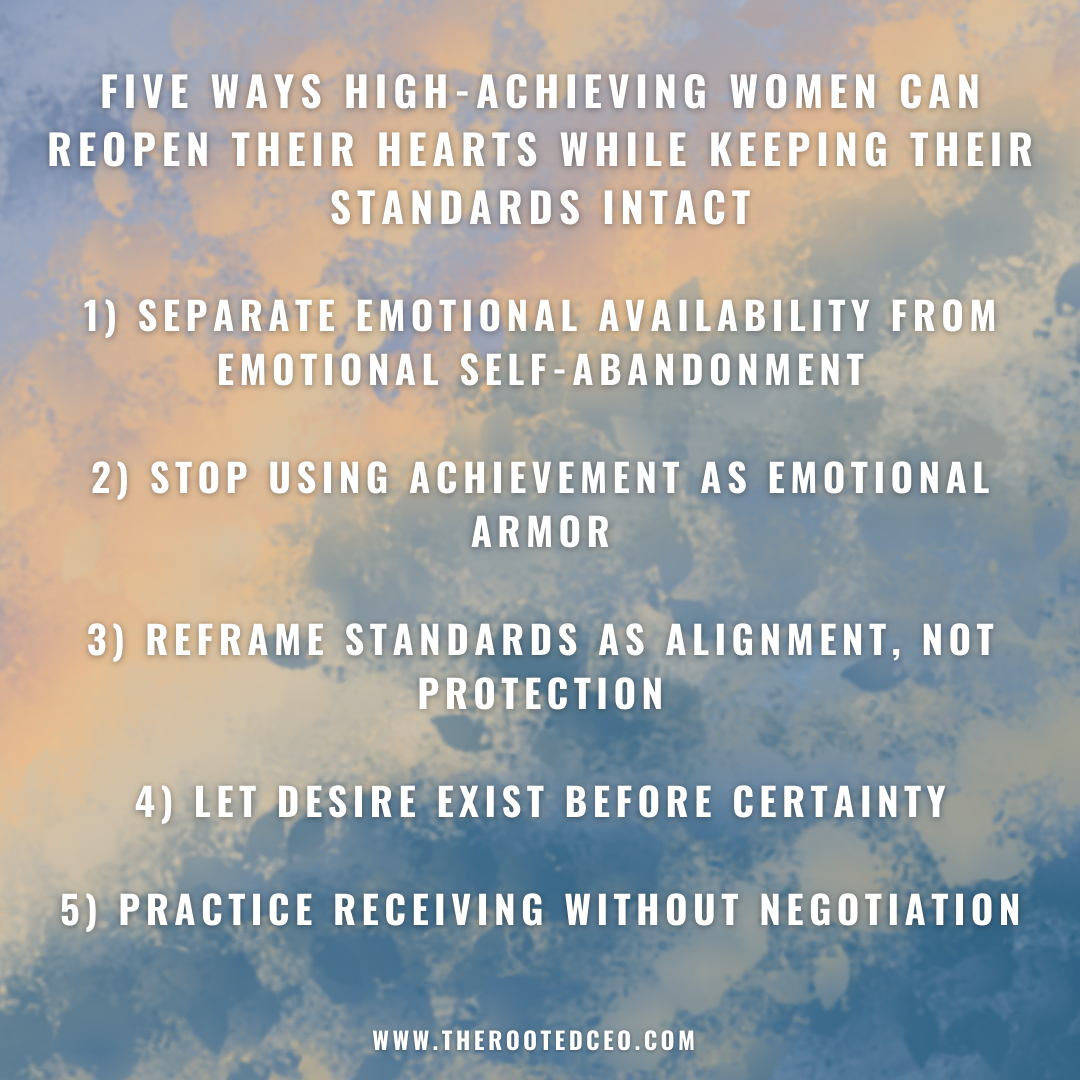
Five ways high-achieving women can reopen their hearts while keeping their standards intact:
1. Separate Emotional Availability From Emotional Self-Abandonment
Many high-achieving women confuse emotional availability with emotional exposure. For high-achieving women, emotional self-abandonment often looks responsible on the surface.
They believe that opening their heart means over-explaining, over-giving, or making space for behavior that has not earned access. Because of this, they stay closed. Not because they are cold, but because they are discerning. It shows up as giving someone the benefit of the doubt when your body already knows better. It looks like staying curious about inconsistency because you can “handle it.” It sounds like explaining away unmet needs in the name of emotional intelligence or growth.
Emotional availability begins when you stop outsourcing your intuition. When you trust the quiet, immediate signals in your body without requiring evidence to justify them. When you allow yourself to name disappointment in real time instead of reframing it into something more palatable.
Ask yourself:
Do I let myself feel desire without immediately questioning it?
Do I allow attraction without mentally listing reasons it will not work?
Do I permit hope to exist before demanding proof?
Reopening your heart does not mean pushing past discomfort. It means paying attention to it.
When you stay emotionally present with yourself, you stop negotiating against your own needs. You no longer overextend to maintain connection. You let interest be mutual. You let effort be reciprocal. You allow space for someone to meet you instead of managing the entire dynamic.
This is how standards stay intact. High standards are not about being guarded. They are about being selective.
You are not available to potential. You are available to presence. You are not open to promises. You are open to consistency. Emotional availability is not a performance. It is an inner alignment that makes your boundaries feel natural instead of defensive. When you stop equating openness with obligation, your heart can soften without becoming unsafe.
2. Stop Using Achievement as Emotional Armor
For many high-achieving women, achievement did not begin as ambition. It began as safety.
Success became the place where you could not be dismissed, ignored, or destabilized. It gave you leverage. It gave you choice. It ensured that even if someone left, disappointed you, or failed to meet you emotionally, your life would remain intact.
That adaptation was intelligent.
But when achievement becomes the primary way you regulate emotion, it quietly limits intimacy. There is little room for vulnerability when your worth is consistently reinforced through output. You are praised for being composed, capable, and resilient, but rarely met in the softer places that do not produce results.
Achievement as armor keeps you from being seen on days when you are uncertain, tender, or simply human.
Reopening your heart requires separating competence from connection. It means allowing parts of yourself to exist without justification. It means letting joy, sadness, longing, and hope surface without turning them into something productive.
This does not dilute your standards or dull your edge. It sharpens your self-awareness.
Ask yourself gently:
Who am I when I am not producing?
What parts of me exist when nothing is being accomplished?
What emotions surface when I stop optimizing my life?
When you allow stillness, creativity, pleasure, and play back into your life, emotion begins to thaw naturally. You do not have to chase vulnerability. You create conditions where it feels safe to emerge. When your identity expands beyond what you do, your relationships gain depth. You stop leading with what you offer and begin meeting others from who you are. Emotional safety stops being something you manufacture and becomes something you experience.
The heart does not open on command. It opens in presence.That is when armor can finally be set down, not because you are unprotected, but because you are no longer under threat.
3. Reframe Standards as Alignment, Not Protection
Many high-achieving and analytical women built their standards after disappointment. When standards are built primarily in reaction to past pain, they tend to be rigid rather than wise.
They are often framed around what you will no longer tolerate instead of what you want to experience. This creates a checklist designed to prevent loss, not invite connection. While this approach can reduce risk, it can also limit intimacy by filtering out emotional nuance.
This wisdom is valid. But sometimes standards quietly morph into walls. Alignment-based standards ask different questions.
When standards are rooted primarily in protection, they narrow possibility. When they are rooted in alignment, they create resonance. They focus less on avoiding familiar wounds and more on identifying how your nervous system responds in healthy connection. You notice whether you feel calm instead of activated. Whether communication feels mutual instead of managed. Whether attraction expands your sense of self rather than putting you on guard.
This is where high standards evolve from defense into discernment.
Protection-based standards often require constant vigilance. Alignment-based standards feel obvious. They do not demand hyper-analysis. They allow curiosity without compromise. You do not have to interrogate every interaction because your body registers coherence early on.
Reopening your heart means trusting that resonance can coexist with boundaries. That emotional safety does not come from control, but from consistency. That attraction does not have to be intense to be meaningful.
Reopening your heart does not require lowering standards. It requires refining them.
Instead of asking:
How do I make sure I am never hurt again?
Ask:
What kind of partnership expands me?
What dynamics bring out my warmth, femininity, and ease?
Who meets me without requiring me to shrink or harden?
Alignment standards feel expansive, not constricting. They invite curiosity rather than suspicion. They allow you to remain open while still honoring your non-negotiables.
When your standards are rooted in alignment, you remain open without being porous. You are selective without being closed. And love becomes something you recognize, not something you rationalize.
4. Let Desire Exist Before Certainty
High-achieving women are conditioned to assess risk before desire. For high-achieving and analytical women, certainty often feels like safety.
You are used to clarity, timelines, and predictable outcomes. You assess, evaluate, and optimize because that approach has served you in nearly every other area of life. But desire does not operate on a spreadsheet. It cannot be audited, accelerated, or guaranteed.
When you require certainty before allowing desire, you unintentionally shut down the very signal that guides you toward aligned connection.
Desire is not a liability. It is information.
When you shut down desire in the name of control, you disconnect from your intuition. It reveals what draws you, what awakens you, and what parts of yourself are ready to be met. Suppressing desire in the name of discernment disconnects you from your intuitive intelligence. You begin making relational decisions solely from logic, leaving no room for chemistry, curiosity, or emotional momentum.
Reopening your heart means letting attraction exist without immediately interrogating it. Allowing chemistry to be felt without rushing to define it. Giving interest space to unfold without forcing it into a future outcome.
This does not mean ignoring red flags or suspending boundaries. It means postponing judgment long enough to experience presence.
When you let yourself feel desire without rushing to contain it, your emotional world regains color. You remember what it is like to want, not just evaluate. When desire is allowed to breathe, it clarifies rather than confuses. It sharpens discernment instead of undermining it. And when paired with standards rooted in alignment, desire becomes an ally, not a risk.
You do not need certainty to feel connected. You need self-trust to stay present while clarity reveals itself over time.
5. Practice Receiving Without Negotiation
High-achieving women are exceptional givers. For high-achieving women, receiving can feel destabilizing because it interrupts a lifetime of self-sufficiency.
You are accustomed to creating security through effort. You plan, provide, anticipate, and problem-solve. When something is given freely, without request or requirement, it can trigger an unconscious urge to equalize the exchange. To offer something back. To prove worth. To stay in control.
Receiving, however, often feels foreign. Or uncomfortable. Or undeserved. But receiving is not passive. It is a skill.
Reopening your heart requires allowing generosity, interest, and care to land without commentary. Without minimizing it. Without translating it into obligation. Without preparing for the moment it might be taken away.
Receive interest without questioning motives. Receive affection without offering something in return. Receive consistency without bracing for loss.
This is where emotional safety is rewired. When someone shows up, let it land.
When you receive without negotiation, you allow your nervous system to experience consistency without hypervigilance. You learn that care does not always come with strings. That presence does not need to be earned. That being chosen does not require performance.
This practice does not soften your standards. It strengthens them.
As you become more comfortable receiving, your tolerance for inconsistency drops. You no longer chase what feels intermittent or confusing. You recognize the steadiness of healthy connection and stop mistaking effort for chemistry.
Receiving becomes the filter. Not who impresses you, but who shows up and stays. And when you let that in, your heart opens naturally, not because you forced it, but because it finally feels safe to do so.
You do not need to earn care. You need to allow it.
The Quiet Truth About Reopening the Heart
Reopening your heart is not a single moment. It is a series of small permissions. Reopening your heart as a high-achieving woman is not a dramatic unraveling. It is a quiet return.
It is the moment you realize that strength and tenderness were never opposites. They were always meant to coexist. That the parts of you that learned to lead, protect, and endure were not meant to replace your capacity to feel, but to support it.
You did not close your heart because you failed at love. You closed it because you adapted. You learned how to survive disappointment with dignity. You learned how to create stability without relying on anyone else. Those skills are not mistakes. They are evidence of resilience.
But survival is not the same as fulfillment.
At this stage of life, love is no longer about proving anything. It is not about intensity, urgency, or sacrifice. It is about resonance. It is about choosing connection that honors who you have become, not who you were when you first learned to protect yourself.
When you reopen your heart without abandoning your standards, you stop bracing for loss and start allowing presence. You let curiosity replace control. You let desire inform discernment. You let consistency, not potential, earn access.
This kind of openness does not make you vulnerable to the wrong things. It makes you unavailable to them.
You begin to recognize what is aligned without over-analyzing it. You feel when something fits without needing to force it into certainty. You trust yourself to walk away when something does not meet you, not because you are afraid, but because you are grounded.
The heart does not open through effort. It opens through self-trust.
And when you lead with that trust, love stops feeling like a risk to manage and becomes an experience you are finally available to receive.
If you’re ready to feel again, not in a dramatic way, but in a quiet, steady return to yourself, start with the books in this blog post and let desire meet you where you are.