The Difference Between Rest and Numbing (And Why High Achievers Often Confuse the Two)

By Megan Ellis | The Rooted CEO
You finally sit down. The to-do list is handled, or at least contained enough to ignore. The kids are settled. The emails can wait until morning. You pour a glass of wine, open Netflix, and scroll until something lands. Two hours later, you close the laptop and feel... nothing. Not rested. Not restored. Just slightly more depleted than before, with the added guilt of having "wasted" the evening.
If that sounds familiar, you are not lazy. You are not ungrateful. And you are definitely not broken.
You may just be numbing when you think you are resting.
This distinction is small on the surface but significant underneath. It is one of the most important things a high-achieving woman can learn to recognize in herself. Because the two feel almost identical in the moment, especially when you are exhausted. But they produce completely opposite results in your nervous system, your emotional range, and your capacity to feel alive.
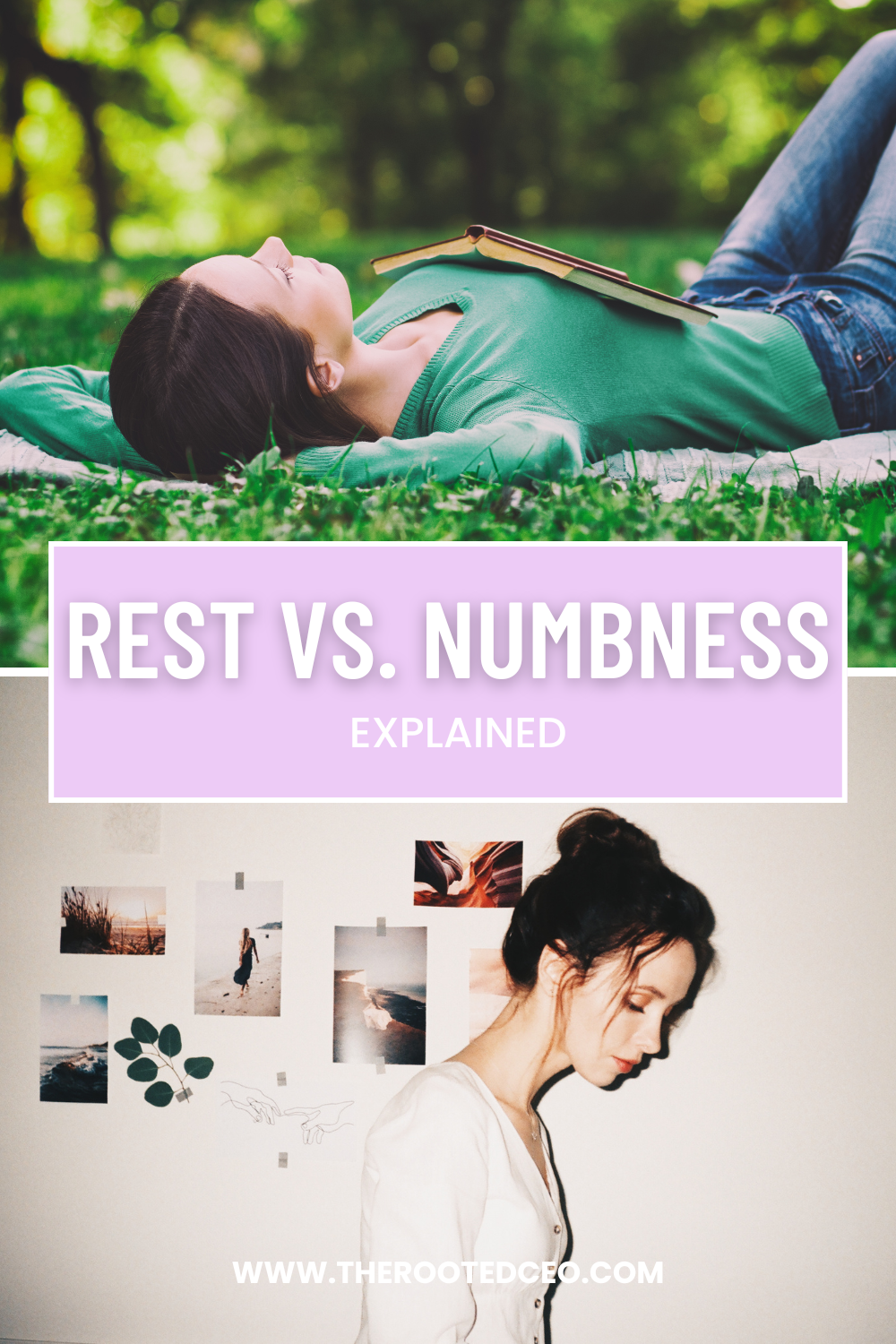
Why High Achievers Struggle to Tell the Difference
Most high-functioning women were never taught what genuine rest actually feels like. What they were taught, explicitly or implicitly, is that productivity is proof of worth and stillness requires justification.
So when exhaustion finally wins and forces a pause, the pause tends to look like escape. Scrolling. Bingeing. Drinking. Eating past the point of hunger. Shopping for things you do not need. Not because you are weak, but because your nervous system has been running on urgency for so long that it does not know how to simply be without going somewhere.
Numbing is not a character flaw. It is a coping response. It is what a highly capable, chronically overstretched system does when it needs relief but does not feel safe enough to actually receive it.
The problem is that numbing never delivers what rest actually provides. It pauses the discomfort without resolving the depletion. You surface from it the same as you went in, or sometimes worse, because now you have spent the time you had and still feel hollow.
What Rest Actually Is (And Is Not)
Rest is not the absence of activity. This is where most definitions fall short.
Genuine rest is any experience that allows your nervous system to move out of activation and into regulation. It is the shift from doing, managing, and monitoring into a state where your body feels safe enough to soften.
That can look like sleep, yes. But it can also look like a slow walk without a podcast. A bath where you are actually present in it. A conversation that feels mutual and warm. Sitting in the sun without checking your phone. Reading something that pulls you in rather than numbs you out. Creative work that asks something from you and gives something back.
What makes something restful is not its appearance but its effect. Does it bring you back to yourself, or take you further away?
Rest restores. It increases your capacity. You come out of it with more presence, more patience, and more access to your own feelings and thoughts. It does not have to be dramatic. Even fifteen minutes of genuine stillness can begin to shift your baseline.
Numbing, by contrast, manages. It temporarily lowers the signal without giving your system what it actually needs. You come out of it roughly the same, or slightly worse, and the original feeling is still waiting for you when the distraction ends.
How to Recognize Numbing in Your Own Life
Numbing is subtle, especially in high-achievers, because it tends to disguise itself as self-care or downtime. A few patterns worth noticing:
You are consuming rather than experiencing. Scrolling, bingeing, and passive absorption can all slide into numbing when they are being used to avoid feeling rather than genuinely enjoy something. There is nothing wrong with watching television or browsing the internet. The question is whether you are doing it with any presence, or simply to not feel what is underneath.
You feel worse after, not better. This is the clearest signal. Rest leaves you more resourced. Numbing leaves you flat, vaguely guilty, or exactly as depleted as before.
You cannot stop when you want to. Genuine rest is something you can move in and out of with some ease. Numbing tends to pull. One more episode, one more scroll, one more glass. That pull is often a sign that what you are trying to avoid is still there, pressing.
You feel nothing, or you feel vaguely ashamed. Numbing tends to produce a particular kind of emotional flatness afterward. Not peace, but flatness. There is a difference. Peace has a quality of settledness and ease. Flatness has a quality of absence. If you finish your downtime feeling empty rather than restored, it is worth asking what you were actually doing with that time.
Why This Matters for Emotional Reconnection
For women navigating emotional numbness, that quiet persistent sense of being disconnected from your own life, the rest versus numbing distinction is especially important.
Emotional numbness does not resolve through more numbing. It actually deepens it.
When you consistently use numbing strategies to manage an already muted emotional landscape, you reinforce the very pattern you are trying to soften out of. You teach your nervous system that feeling is something to be avoided and that relief only comes through escape. Over time, this makes genuine aliveness harder to access, not easier.
One tool that can genuinely support this transition is nervous system audio work. The Security and Stability Subliminal from The Rooted CEO shop is an 8-hour reprogramming audio designed specifically to build a felt sense of safety and stability at the nervous system level. It works while you sleep, which makes it one of the lower-effort ways to begin shifting out of a chronic stress state. If your system has been wired for urgency for a long time, this kind of consistent, gentle input can start to create new baseline patterns over time.
Rest, on the other hand, is one of the primary pathways back into emotional range. When your body finally feels safe enough to stop performing and managing, feelings that have been held at a distance often begin to surface gently. Not dramatically. Not in ways that overwhelm. Just more texture. More sensation. More of yourself coming back online.
This is why rest is not passive. For a woman who has been emotionally compressed by years of responsibility, survival mode, or grief, genuine rest is actually a form of quiet courage.
7 Practical Ways to Begin Shifting From Numbing to Rest
You do not need to overhaul your evenings or add a rigorous self-care routine. This is not about doing more. It is about doing differently, and starting small.
Notice without judgment first. Before you try to change anything, just start noticing. When you reach for your phone, your wine, your next episode, what are you feeling? What are you moving away from? Curiosity here is enough. You do not have to fix anything yet.
Give yourself one genuinely slow thing each day. Not a structured meditation if that feels like another task. Something simpler. Five minutes of sitting outside without a purpose. Making tea and actually tasting it. A short walk without earbuds. One small window of presence, offered to yourself without agenda.
Try something that occupies your hands. This is where active rest becomes accessible even for women who cannot sit still, and especially for those of us with ADHD who find pure stillness nearly impossible. The key is that your hands are engaged and your output expectations are low. You are not producing anything. You are just present in the doing. One thing I have been loving lately for exactly this purpose is the Lifelines FlowArt Activity Pads. They are guided dot art meditation pads designed specifically to get you into a calm flow state through gentle, repetitive movements. There is no skill required, no pressure to create something beautiful, and no wrong answers. You just follow the dots. For an analytical brain that struggles to power down, having that simple structure to follow makes rest actually feel possible.
Lower the bar for what counts. Many women dismiss restful experiences because they feel unproductive or too small. A fifteen-minute bath counts. A conversation with a friend that made you laugh counts. Sitting in your car for an extra few minutes before going inside and just breathing counts. Rest does not have to be elaborate to be real.
Let yourself feel bored sometimes. Boredom is uncomfortable for high-achievers because it creates space, and space often means the quieter feelings have room to surface. But boredom is actually a prerequisite for genuine rest. It is the precursor to presence. Tolerating it, even briefly, builds your capacity to receive stillness rather than flee it.
Use audio support while you sleep. If your nervous system is running high even in the hours when you are technically offline, overnight subliminal audio can do quiet work while you rest. The Security and Stability Subliminal is specifically built for this and pairs well with the intention of creating more safety in your system over time.
Ask yourself one orienting question. Am I coming back to myself, or going away from myself? You do not need a framework. You just need to be willing to answer honestly.
A Note on Compassion
If you recognize yourself in the numbing patterns described here, please do not add it to your list of things you are doing wrong.
You are doing what any exhausted, highly capable, chronically overstretched person does. You are finding relief in the ways that are available to you. That is not failure. That is adaptation.
The work is not to shame yourself out of numbing. It is to slowly and gently build more capacity for the alternative. To create enough safety in your days that rest becomes possible, not just as a concept, but as an actual experience you can access without forcing it.
You do not have to feel everything right now. You just have to be willing to feel a little more than you did before.
That is enough. That is, in fact, exactly where this begins.
If this resonated with you, explore more on emotional flatness, nervous system safety, and gentle reconnection at The Rooted CEO. You might also enjoy: Why High Achievers Feel Emotionally Numb (And How to Reawaken Your Range) and How Slowing Down Restores Emotional Aliveness.
This post contains affiliate links. As an Amazon Associate and through my own shop, I may earn a small commission from qualifying purchases at no extra cost to you. I only recommend products I genuinely believe in.