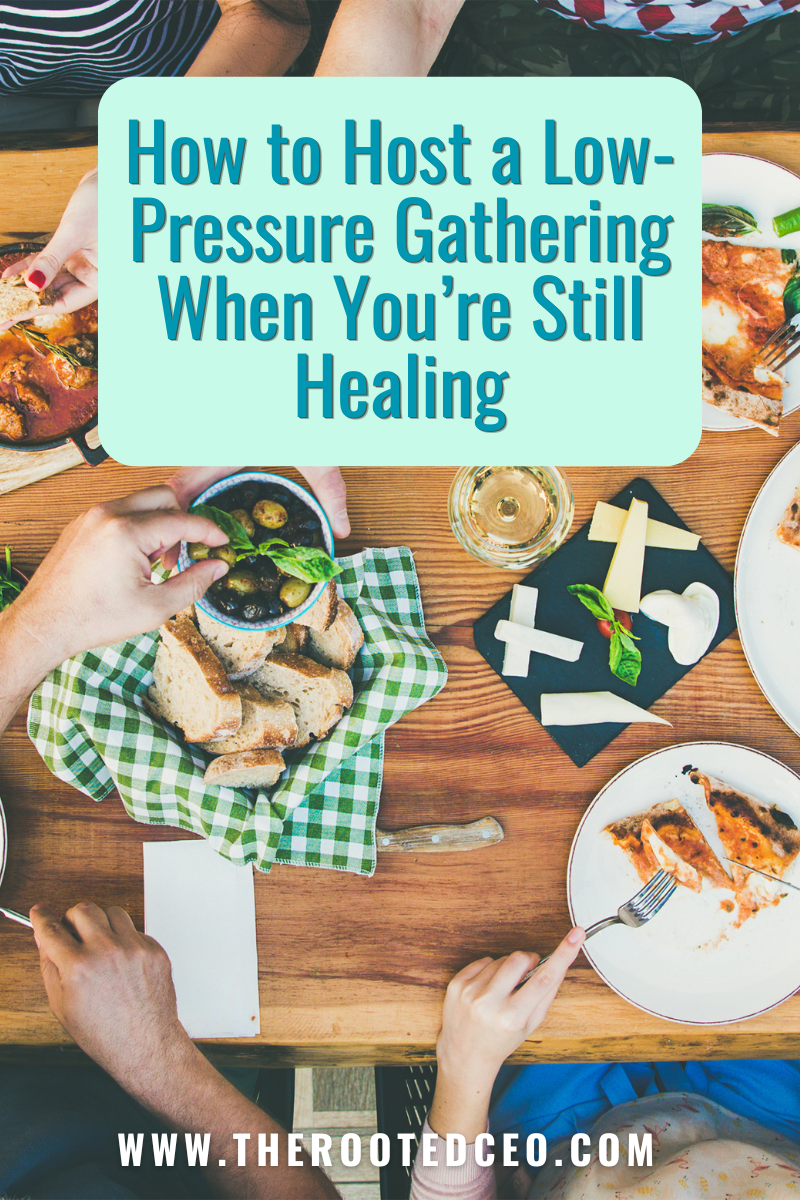
How to Host a Low-Pressure Gathering When You're Still Healing
This post contains affiliate links. If you purchase through a link on this page, I may earn a small commission at no additional cost to you. I only recommend products I genuinely use or believe would support the work described here.
For the woman who misses connection but cannot sustain the performance of a dinner party right now.
There is a specific kind of loneliness that arrives in the aftermath of a major life transition. It is not the loneliness of being alone. It is the loneliness of being in a season where connection feels both deeply necessary and inexplicably hard. The idea of having people over sounds good in theory. And then the day arrives and suddenly the cleaning, the cooking, the performing, the managing of conversation, the maintaining of the appearance of having it together — it all feels like too much.
So you cancel. Or you never send the invite. And the isolation deepens.
This post is about a different kind of gathering. One that does not require a performance. One that still gives you what gathering is actually for.
What Gathering Is Actually For
The traditional dinner party is a performance. There is a host and there are guests. The host provides the food, the environment, the energy, the conversation, and the cleanup. The guests receive. This arrangement works well when the host has surplus to give.
When you are healing, you do not have surplus. What you have is a need for connection: genuine, low-stakes, pressure-free contact with people who are safe. The dinner party model does not serve that need. It taxes it.
Research on nervous system regulation consistently points to co-regulation as one of the most direct routes back to baseline after prolonged stress. Co-regulation is the physiological settling that happens when you are in the physical presence of safe people. You are not being indulgent by wanting to see your people. You are following a biological directive.
The low-pressure gathering starts from a different premise: the purpose of this is connection, not production. Everyone leaves feeling more resourced than they arrived. Including you.
You do not need to earn connection by performing for it.
The Soft Hosting Framework
What follows is what I call the Soft Hosting Framework: five practical shifts that make gathering feel possible even when you are running on a depleted tank.
1. Move from the hosted model to the contribution model.
You do not have to provide everything. The single most liberating shift you can make is deciding that everyone brings something. You provide the space and one anchor element. Guests bring food, a drink, a dessert, themselves. The gathering is co-created.
This is not a dutiful potluck. It is a genuine distribution of the relational load. And it communicates something important to your nervous system: you do not have to hold everything. You are allowed to let other people contribute.
If you want something to set out on the table without cooking, a simple grazing board works well here. You can find charcuterie and snack board sets on Amazon that make assembly straightforward without any real effort.
2. Use a grazing board as your social architecture.
A grazing board removes the highest-anxiety element of hosting: the performance of a meal. Nobody is waiting to be served. Nobody is eating on a schedule. The food is present, abundant, and low-maintenance. Conversation happens at any pace. People can arrive and leave with less ceremony.
For a woman who is healing, this format is specifically useful because it takes the meal off the table as a source of stress. Build it out of things that require no cooking: cheeses, crackers, fruit, dips, olives, nuts. Set it out. Done. A good quality board and a few small bowls are the only tools you need.
3. Take it outside.
Outdoor gatherings are inherently lower pressure than indoor ones. The space is already ambient. You do not have to clean your house. The backdrop is handled. A backyard, a park, a balcony: any of these create the feeling of occasion without the prep load of a staged interior.
You do not need a beautiful backyard. You need chairs, daylight, and people you trust.
4. Keep the guest list small.
This is not the season for the big gathering. It is the season for the intimate one. Three or four people you genuinely want to see, for an amount of time that feels manageable rather than ambitious.
A two-hour Sunday afternoon. A quiet Tuesday evening. A walk followed by wine on the porch. The intimacy of a small gathering is also emotionally safer. You do not have to manage a room. You just have to be present with a few people who already know what your life has looked like recently.
5. Set a defined end time before people arrive.
This one is underused and quietly powerful. When you know the gathering has a built-in boundary, you can actually relax into it. Tell people when you are wrapping up. "I am thinking we will call it around four" is not rude. It is honest, and it protects your energy before the gathering even begins.
A planner or simple notepad can help you think through the logistics ahead of time so the planning does not live in your head. I have been using a structured weekly planner to map out the few things that need to happen before a gathering. Nothing elaborate, just enough to get it out of my nervous system and onto paper.
The Real Reason You Are Not Hosting
The deeper reason women in healing do not host is not logistics. It is the belief that hosting requires you to have arrived somewhere. To be doing well enough that you can present a version of your life that is worthy of guests.
This is the story worth updating.
Connection is not a reward for having it together. It is one of the primary mechanisms of nervous system co-regulation. Meaning, it is something you genuinely need in order to keep healing. Isolating until you are better is not how better happens.
A gathering does not have to be impressive to be restorative. It just has to be honest, low-stakes, and with the right people.
Those are the ingredients. The rest is details.
3 Signs This Season Is Calling You Toward Connection
Not sure if you are ready? You probably are if any of these feel true:
You find yourself scrolling through contacts and feeling a pull toward specific people, but talking yourself out of reaching out.
You feel better, noticeably and physically better, after spending even an hour with someone safe, and the effect fades quickly when you are alone again.
You have been postponing social plans for weeks under the premise that you will feel more ready later, and later keeps moving.
These are not signs that you need more time alone. They are signs that your nervous system is asking for the thing that will actually help.
Start Small. Start Soft.
You do not have to host a gathering this weekend. You do not have to host one this month. But if the idea landed somewhere in your body when you started reading this, that is worth paying attention to.
The Soft Hosting Framework is not about doing more. It is about doing less, more honestly, with the people who matter. That is what gathering has always been for.