The Books I Read in July 2026 (And Why Liking Almost All of Them Surprised Me)
I usually read constantly. Some months I read a lot more than others especially when life gets loud, and somewhere in the middle of rebuilding a business, a household, and a version of myself I actually recognize, the stack on my nightstand turned into decoration. This post is about what happened when I picked it back up. I’m truly trying to work through my physical stack of books as part of my decluttering process in preparation for moving once my house is sold.
This post contains affiliate links. If you purchase through a link on this page, I may earn a small commission at no additional cost to you. I only recommend products I genuinely use or believe would support the work described here.
Why Reading Fiction Again Was Never Just About the Books
For a long time, reading felt like a luxury I had to earn. Something I'd get to once the inbox was empty, the invoices were sent, and everyone else's needs were met first. If you're rebuilding your life after a divorce, running a business solo, or parenting without a partner to tag out with, you know how quickly "later" becomes "never."
This July, I didn't wait for permission. I picked up nine books in 31 days, not because I had more time, but because I finally treated reading like something that belonged to me and not something I'd get around to eventually.
That distinction matters more than it sounds like it should. Nervous system regulation isn't only breathwork and cold plunges. Sometimes it's twenty minutes with a paperback instead of my phone. Fiction, specifically, asks something different of my brain than scrolling does. It slows me down. It requires me to stay in one place long enough to follow a thread. If your days are full of context switching, that alone is a form of rest, and it's one of the few forms of rest that doesn't ask you to lie still and do nothing, which for a lot of analytical brains is its own kind of impossible.
How I Chose What Made the Stack
I didn't sit down in June and plan a curated July reading list. That's part of the point. For most of this year, the few books I did pick up were chosen the way I choose everything else, strategically. Would this teach me something. Would this make me better at my job. Would this be a productive use of the twenty minutes before I fell asleep.
July broke that pattern almost by accident. A friend handed me a paperback. A cover caught my eye at a bookstore I wasn't planning to enter. A thriller showed up on a recommendation list and I bought it out of curiosity instead of obligation. None of these were strategic choices. That's exactly why they worked.
Looking back at the stack now, I can see a rough shape to it, even though I never consciously built one. A few literary novels with real emotional weight. A couple of thrillers for pure momentum. A cozy fantasy with no stakes at all. A beach read or two that asked nothing of me. If I had tried to engineer that balance in advance, I probably would have overthought it into something joyless. Instead it happened the way most honest things happen, without a plan.
The Permission Shelf
Here's the framework I built without meaning to: The Permission Shelf. It's the idea that I keep a small, rotating stack of books I'm allowed to read purely because they interest me, with zero productivity justification required. Not books for research. Not books to optimize my business or my parenting. Books because the cover caught me, or the premise did, or a friend wouldn't stop talking about it.
The Permission Shelf has three rules:
Nothing on it has to teach me anything.
I'm allowed to abandon a book at any point without guilt.
At least one book per stack has to be something I wouldn't have admitted to reading five years ago.
That third rule is the one that changed July for me. It's also where the surprise came in. I used to have a mental hierarchy of what counted as a "real" book, the kind I'd mention if someone asked what I was reading, versus the kind I'd read quietly and never bring up. This July I stopped sorting my reading into those two categories, and the books I enjoyed most were often the ones I would have hidden a few years ago.
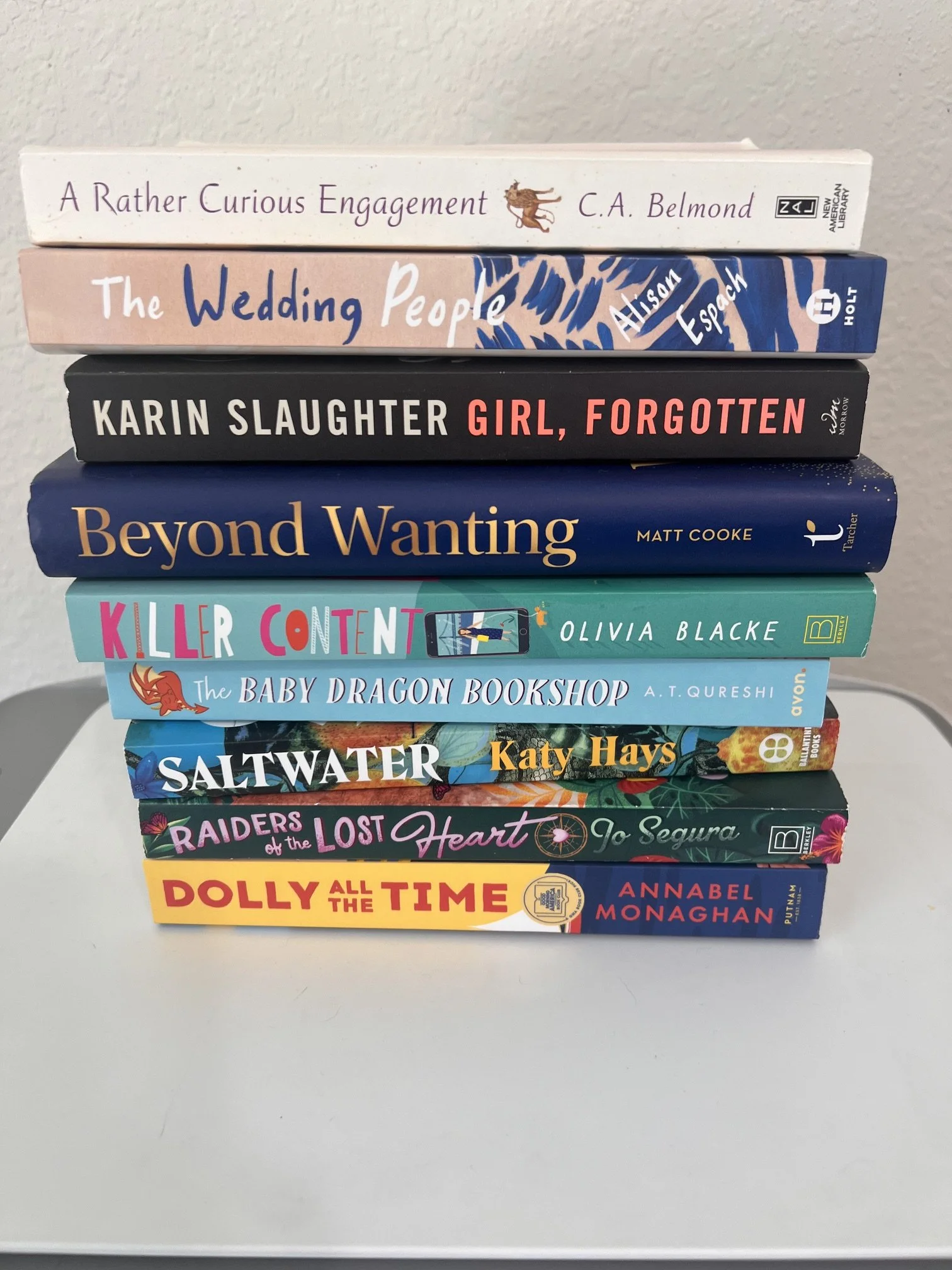
The 9 Books That Made the Cut in July
I went in expecting to like maybe half of these. Here's what actually happened.
A Rather Curious Engagement by C.A. Belmond. Light, European, art-world mystery energy. Good for a night when my brain needed a plot to follow but not one that cost me anything emotionally. I read most of it in two sittings, which tells you how little friction it had. Get it here on Amazon: https://amzn.to/4cFfIeW
The Wedding People by Alison Espach. This one surprised me the most. Sharper and more emotionally honest than the cover suggests. It sat with grief and reinvention in a way that felt uncomfortably familiar, and I found myself underlining sentences I wasn't expecting to relate to. Get it here on Amazon: https://amzn.to/4gt8cpX
Girl, Forgotten by Karin Slaughter. Dense, dark, well-built. I needed proof my attention span still works, and a Slaughter thriller will test it. This is not a book you read distracted, and I liked being reminded that I could still give something my full attention. Get it here on Amazon: https://amzn.to/4gjXh0K
Beyond Wanting by Matt Cooke. The outlier of the stack. Not for everyone, but it earned its spot precisely because it didn't try to be comfortable. Get it here on Amazon: https://amzn.to/4gcz6B4
Killer Content by Olivia Blacke. Fast, a little campy, exactly what a Permission Shelf book should be. I read half of it in a waiting room and didn't mind the wait. Get it here on Amazon: https://amzn.to/4wrIeI4
The Baby Dragon Bookshop by A.T. Qureshi. Cozy fantasy that asked nothing of me except to enjoy it. I needed that more than I expected, especially after the heavier books earlier in the stack. Get it here on Amazon: https://amzn.to/4gh2INL
Saltwater by Katy Hays. Atmospheric, art-world tension again, the kind of book that made me want to sit somewhere quiet with it and not check my phone between chapters. Get it here on Amazon: https://amzn.to/4wZvedT
Raiders of the Lost Heart by Jo Segura. Pure fun. No apologies. Sometimes a book's only job is to be enjoyable, and this one did its job well. Get it here on Amazon: https://amzn.to/4wZvedT
Dolly All the Time by Annabel Monaghan. Warm without being saccharine, which is rarer than it should be in this genre. I closed it feeling lighter than when I opened it. Get it here on Amazon: https://amzn.to/4zASG35
Nine books, nine different reasons I kept turning pages. That's the part worth sitting with.
What Surprised Me About Liking Almost All of Them
I expected to be a harsher critic than I was. Post-divorce, post-burnout, most people describe becoming pickier, more protective of their time and attention. I did become protective. I just got surprised by what earned the protection.
Liking eight out of nine books isn't really a statement about the books. It's a statement about what happens when I stop reading defensively, bracing for something to disappoint me or teach me a lesson, and start reading for the plain, uncomplicated reason that a story pulled me in. That shift, from vigilance to trust, is the same shift a lot of identity rebuilding runs through. I'm not just relearning what I like. I'm relearning that I'm allowed to like things without justifying them, and that the justifying itself was part of what made reading feel like a chore for so long.
Paperback Versus Kindle, and Why It Mattered This Month
I read all nine of these in physical copies, which wasn't a conscious decision at first but became one by the third book. There's something about a stack of physical books that a Kindle library can't replicate. I can see the stack grow. I can feel the weight of what I've finished shift from the nightstand to the shelf. For a brain that spends most of its day looking at screens, a paperback is one of the only things left in my routine that doesn't glow back at me.
That's not a knock on e-readers. There are seasons where a Kindle is the only realistic way to keep reading, especially while traveling or juggling a schedule that doesn't allow for carrying a hardcover around. But this July, the physical stack itself became part of the practice. Watching it grow was its own small, visible proof that I was making room for something that belonged only to me.
Narrative Rest
If nervous system language feels overused, here's a concrete version of it: narrative rest. It's the specific kind of recovery that happens when my mind gets to follow someone else's story instead of narrating my own for a while. I don't need to solve anything in a novel. I just need to stay present in it. That's a different muscle than the one I use running a household or a business, and it needs its own maintenance, the same way physical rest does.
If you're looking for a way back into reading after a long dry stretch, start smaller than you think you need to. A Permission Shelf of three or four books, genre-mixed, zero pressure, is enough to rebuild the habit. The Erin Condren reading tracker inserts pair well with this if you like seeing the stack grow on paper instead of just in your head, the same way I liked watching my physical stack shrink and shift all month.
I don't need every book on my shelf to change me. Some of them just need to remind me that I still know how to sit still long enough to finish something for no reason but my own enjoyment.
That's the whole practice.