How High-Achieving Women Rebuild Emotional Connection After Divorce
The impact of divorce does not always look like devastation like you see in the movies. For many high-achieving women, it looks like competence and a bit like a bland life.
Life continues. Work gets done. Children are cared for. Responsibilities are met. From the outside, things appear stable, even successful. Internally, though, something often feels distant or muted.
Not sadness exactly. Not despair. More like emotional quiet.
This experience is beyond common among capable women who are used to functioning under pressure and weirdly enough, it doesn’t really get talked about. Emotional disconnection after divorce is not a personal failure or a lack of healing. It is often the nervous system’s way of maintaining stability after prolonged stress and loss.
This guide is written for women who are intelligent, self-aware, and functional, yet feel emotionally flat or numb after divorce. Women who have processed what happened intellectually but still feel disconnected from desire, depth, or inner vitality. I wish I would’ve come across this years ago to help me with my struggle of feeling emotionally numb to help; I hope this will help if you feel like all the advice you come across is just not hitting right.
Rebuilding emotional connection is possible and may take longer than you originally anticipated. It just requires a different approach than most advice offers.
What Emotional Disconnection Looks Like After Divorce
Emotional disconnection does not always announce itself clearly. It often shows up quietly, woven into daily life.
Many women describe feeling “fine” while simultaneously feeling absent from their own experience. It usually isn’t until years later that you realize that there should be something more than just feeling fine and confused on how this snuck up on you without noticing it.
Here are some of the most common ways emotional disconnection presents after divorce.
Numbness
Emotions feel blunted or distant. You may know intellectually that something should feel meaningful, but the emotional response does not arrive. Highs and lows flatten into a narrow range of neutrality.
Lack of desire
Desire fades in general. This can include romantic desire, sexual interest, creative drive, or even simple preferences. Decision-making becomes practical rather than intuitive. Wanting feels unfamiliar. If you have ever uttered the phrase “I just want someone to make all of the choices for me without me thinking about it”, that is a clue that lack of desire has snuck on in there.
Going through the motions
Life becomes a series of tasks. A long checklist of things you need to get done on the hamster wheel of life. You do what needs to be done efficiently and responsibly, but without a sense of emotional presence. Days blur together. You may struggle to recall when you last felt genuinely engaged.
Over-functioning
You compensate for emotional distance by doing more. You stay busy. You manage everything in both your professional and personal life. You take care of others and become the rock everyone expects to be there at all times. Productivity becomes a substitute for connection.
These patterns are not signs that something is wrong with you. They are adaptive responses to prolonged emotional strain.
Why Emotional Flatness Is Common in Capable, Analytical Women
Emotional flatness is especially common in women who are used to responsibility, leadership, and self-containment.
Several practical factors contribute to this experience.
Nervous system overload
Divorce is not a single event. It is often a long period of cortisol inducing stress that includes conflict, uncertainty, grief, and logistical strain. Even after life stabilizes, the nervous system may remain in a guarded state. Emotional dampening is one way the body conserves energy.
Control and self-protection
Capable women often learn early that control equals safety. After divorce, maintaining control can feel essential to get through one day at a time. Emotional openness may feel risky, inefficient, or destabilizing, so the system minimizes emotional input.
Survival mode
During periods of high demand, the brain prioritizes function over feeling. This is not avoidance. It is triage. Over time, however, survival mode becomes habitual, and emotional access remains offline even when the crisis has passed.
Identity fragmentation
Divorce often disrupts identity. Roles shift. Future plans dissolve and you need to process the grief of the life you had and had envisioned is no longer what you have anymore. The version of yourself that existed within the marriage may no longer fit. Emotional disconnection can arise when identity has not yet reorganized.
Understanding these mechanisms matters because emotional flatness is not caused by a lack of effort or insight. It is the result of a system that adapted to get you through something difficult.
Why “Just Be Open” or “Manifest Love” Doesn’t Work for Everyone
This has been one of the areas that I have struggled with and didn’t understand why it was taking me years to see any movement on even though I was following all of the advice. Much of the advice aimed at post-divorce women assumes emotional readiness.
“Open your heart.”
“Trust again.”
“Visualize the relationship you want.”
For analytical minds, this advice often feels vague, frustrating, or even invalidating. Actually real talk, it is beyond frustrating and will just plain piss you off when you keep doing that and nothing is moving.
Unstructured emotional guidance fails for several reasons.
First, it assumes that emotional access is already available. If your nervous system is still guarded, openness is not a choice. It is a capacity that must be rebuilt.
Second, it lacks containment. Analytical women thrive within frameworks and knowing where the guardrails are. When advice offers intention without structure, it can feel unsafe or ungrounded.
Third, it often skips or grazes over the necessary foundational steps. Emotional connection cannot be manifested before emotional safety exists. Desire cannot be accessed while the system is still protecting itself.
Finally, this type of advice can create self-blame. When it does not work, women assume they are doing it wrong or are emotionally blocked.
For some of us, emotional reconnection does not require more positivity or visualization. It requires practical, repeatable experiences of safety, agency, and self-trust.
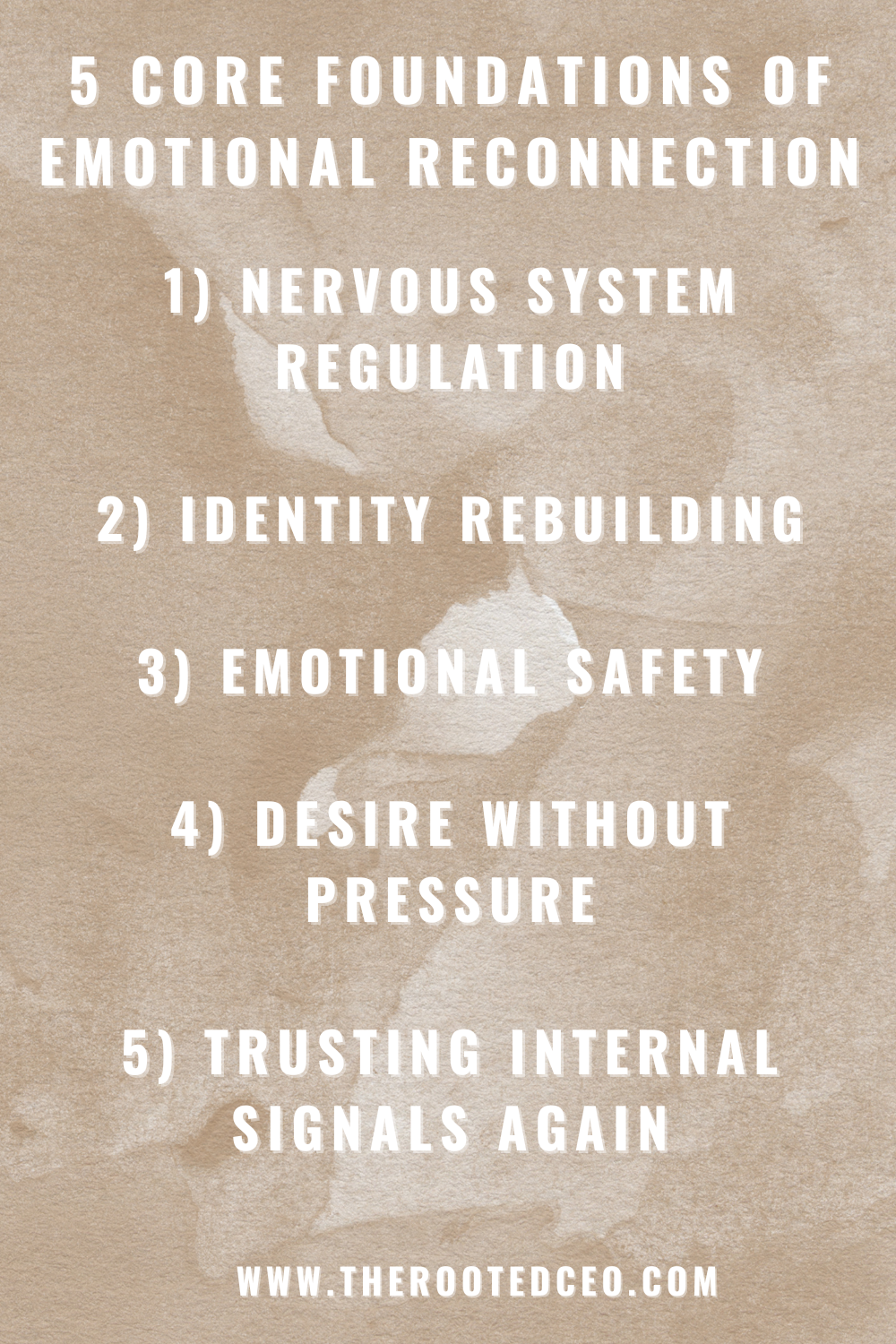
The 5 Core Foundations of Emotional Reconnection
Emotional reconnection is not one breakthrough moment. It is a gradual rebuilding process. The following five foundations provide a practical structure for that process. As you are working through each of these, think about when was the last time you really spent any time on these on a daily basis. Has it been one month, one year, five years, never?
Whatever your answer, just know that it is okay and you won’t always feel (or not feel, in my case) like this forever. I like to relate it to a flower bud unfurling itself in the springtime after a long winter. It happens very slowly until one day, you notice a beautiful flower.
1) Nervous System Regulation
What it is
Nervous system regulation refers to the body’s ability to move out of constant alertness and into states of rest, curiosity, and connection.
Why it matters
Emotions cannot fully surface when the nervous system perceives threat. Regulation creates the internal conditions necessary for feeling.
Practical example
Establish a daily decompression ritual that signals safety. This might be a slow walk without headphones, sitting outside for ten minutes, or practicing gentle breathing before bed. Consistency matters more than duration.
2) Identity Rebuilding
What it is
Identity rebuilding involves redefining who you are outside of the marriage, outside of motherhood (if that applies to you), and outside of survival roles.
Why it matters
Emotional connection requires a stable sense of self. When identity is fragmented, emotions feel unanchored or confusing.
Practical example
Begin noticing choices that reflect who you are now, not who you were. This could be as simple as changing routines, redefining boundaries, or exploring interests without needing them to be productive.
3) Emotional Safety
What it is
Emotional safety is the internal experience of being able to feel without judgment or consequence.
Why it matters
If emotions were previously dismissed, weaponized, or ignored, the system learns to suppress them.
Practical example
Create at least one environment where you are not performing. This may be time alone, a trusted friend, or a therapist. The key is emotional neutrality, not problem-solving. Something that has been very helpful for me in getting into this habit is doing morning pages that the Artist’s Way suggested.
4) Desire Without Pressure
What it is
Desire without pressure means allowing wants to emerge organically rather than forcing passion or attraction.
Why it matters
Pressure shuts desire down. Reconnection begins with preference, not intensity.
Practical example
Practice asking low-stakes preference questions. What sounds good to eat? What pace feels right today? What do I want less of this week? These small choices rebuild desire safely.
5) Trusting Internal Signals Again
What it is
This foundation focuses on restoring confidence in your own emotional and intuitive responses.
Why it matters
After divorce, many women second-guess themselves especially as they are getting back into romantic relationships. Emotional reconnection requires self-trust.
Practical example
Notice when you override discomfort. Practice pausing before dismissing internal signals. You do not need to act on every feeling. You only need to acknowledge them.
How Long Emotional Reconnection Takes (And What’s Normal)
Honestly, there is no universal timeline for emotional reconnection after divorce.
For many women, emotional access begins to return gradually over six to eighteen months, depending on several factors:
Length and intensity of the marriage
Level of emotional suppression during the relationship
Current stress load
Availability of emotional safety
Honestly for me, it took about six years. I feel like I have taken in a big gulp of air after being below water for an extremely long time. Reflecting back on why it feels like it has taken forever for me, I had a combination of things going on. First, I had and continue to have a lot of ongoing stress with my career and second, I was having a hard time moving forward from a relationship I had after being divorced that kept me stuck in that place of numbness.
It is normal for reconnection to feel slow and uneven. Periods of clarity may alternate with emotional flatness. This does not mean regression.
Progress often looks subtle:
Increased emotional awareness
Clearer boundaries
Gentle curiosity
Reduced tolerance for misalignment
Reconnection is not dramatic. It is stabilizing with little steps forward.
Common Mistakes That Keep Women Emotionally Stuck
Treating emotional reconnection as a productivity goal
Expecting desire to return before safety is established
Forcing vulnerability prematurely
Over-intellectualizing emotional experiences
Staying constantly busy to avoid stillness
Comparing your timeline to others
Awareness of these patterns prevents unnecessary frustration and I would’ve loved for someone to share this with me when I was newly divorced. It could have saved a lot of tears and sadness of why things weren’t moving for me.
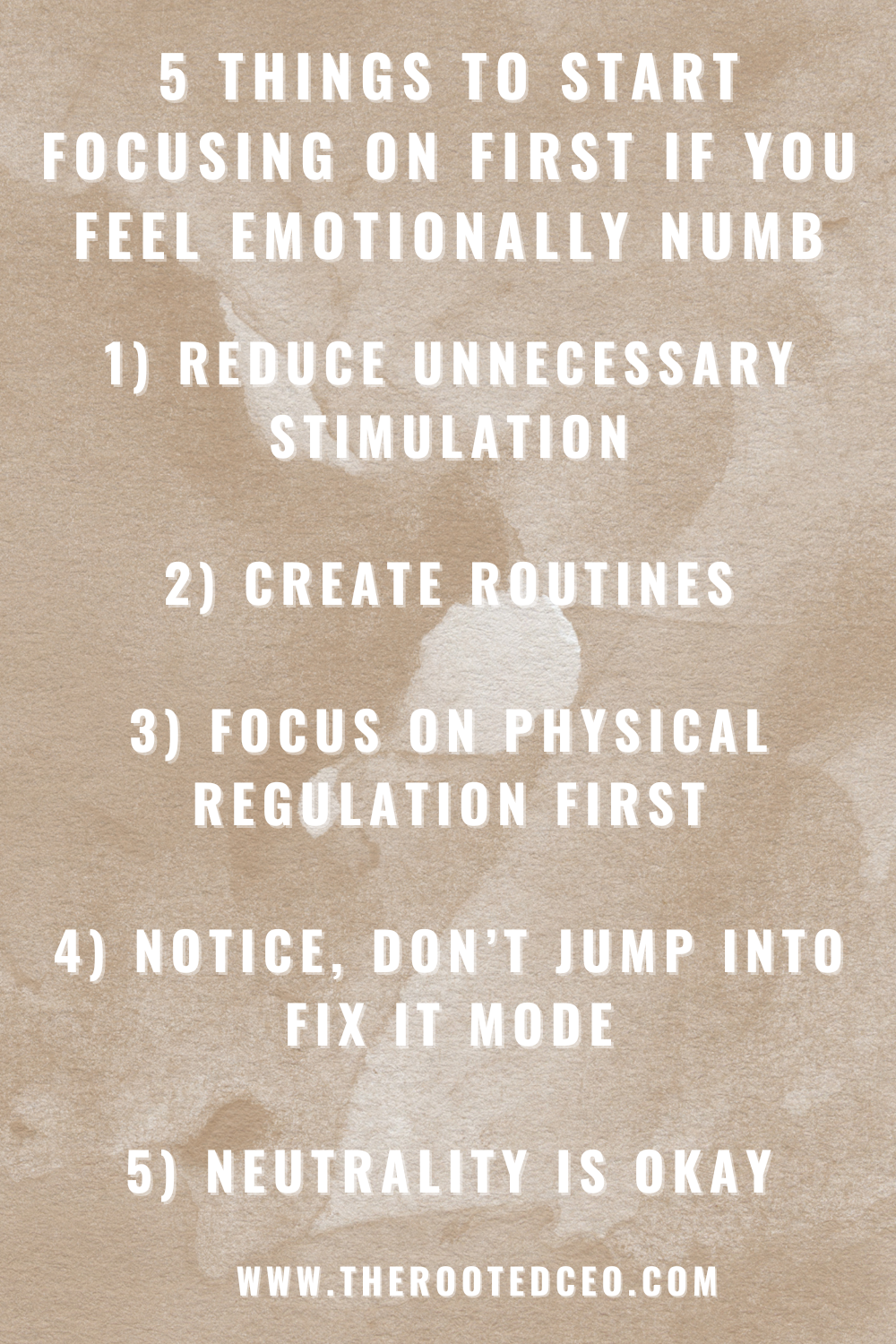
What to Focus on First If You Feel Emotionally Numb Right Now
If emotional numbness is present, start with containment with a simple framework, not exploration.
A simple starting framework includes:
Reduce unnecessary stimulation
Create predictable routines that include rest
Focus on physical regulation before emotional processing
Practice noticing without fixing
Allow neutrality to exist without labeling it as failure
Emotional reconnection will begin to happen when the system feels safe enough to feel again. If no one has told you or told you lately, it is normal for you to not feel much of anything right now and you will be okay. I promise the emotional reconnection will happen when you are truly ready for it.
Sending you lots of love and hugs!
Megan
About the Author
Megan Ellis is a consultant, strategist, and writer with over a decade of experience working with high-functioning professionals in high-pressure environments.
After spending years advising organizations on complex systems, risk management, and long-term strategy, Megan began writing about emotional reconnection for analytical women navigating life transitions such as divorce, identity shifts, and burnout.
Her work focuses on practical emotional frameworks that respect intelligence, autonomy, and real-world constraints. She writes for women who are capable, responsible, and outwardly successful, yet quietly disconnected from their inner world.
Through her writing, Megan helps women rebuild emotional connection in ways that feel grounded, sustainable, and self-trusting rather than performative or prescriptive.