5 Ways to Reconnect with Desire and Self-Trust for Analytical Women
Many high-functioning women reach a point where life looks stable on paper but feels strangely muted internally. Work is being handled. Responsibilities are met at home. Decisions are made efficiently. Yet desire, intuition, and emotional clarity feel like they left the building a long time ago.
This experience is especially common among analytical women who are used to thinking their way through problems. Emotions, who’s she? When emotional connection fades, the instinct is often to analyze it further or push through it. This approach can and will deepen the disconnection instead of resolving it.
This guide explains why desire and self-trust often shut down in analytical women and offers five practical, realistic ways to rebuild both without abandoning logic or control.
Table of Contents
What Desire and Self-Trust Actually Mean
Why Analytical Women Lose Access to Desire
Why “Just Listen to Your Heart” Rarely Works
A Practical Framework for Rebuilding Desire and Self-Trust
Shift from “Figuring Out” to Noticing
Reduce Internal Override Patterns
Reintroduce Low-Stakes Desire
Practice Decision Follow-Through
Allow Desire to Evolve Slowly
How Long Reconnection Typically Takes
Common Mistakes That Delay Reconnection
Final Thoughts
What Desire and Self-Trust Actually Mean
Desire is not limited to romance or intimacy, even though those are in its definition orbit. In practical terms, desire includes:
Knowing what you want before explaining it
Feeling pulled toward choices rather than forcing them
Experiencing curiosity, motivation, excitement or anticipation
Responding to internal signals instead of overriding them
Self-trust is the ability to rely on your internal cues when making decisions and feel good once you made those decisions. It shows up as:
Confidence in your timing
Comfort with uncertainty and not pushing or rushing with clarity
Willingness to adjust without self-judgment
Following internal signals even when they are not fully rational. If you just know in your gut that decision is right for you, that is a sign you are following self-trust.
When desire and self-trust weaken over time, women often describe feeling flat, disconnected, or overly cautious, even when they are successful and capable. For me, I just felt off in my body and emotions. Life was feeing blah and greywashed like the beginning of the Wizard of Oz and I knew something drastic needed to happen to get it to change.
Why Analytical Women Lose Access to Desire
Analytical women are often praised for being logical, reliable, and composed. Over time, these strengths can quietly override emotional awareness since this is more of their natural state of setting emotions aside to get shit done.
Common contributors include:
Over-reliance on logic
When every decision is filtered through analysis, any emotional signals may be dismissed as unreliable or inconvenient. This creates a habit of ignoring internal feedback and pushing those emotions down to deal with at a later, more convenient time. Newsflash - you don’t deal with those emotions and they either get stuck in your body or bubble out.
Chronic self-monitoring
High performers often track outcomes, efficiency, and results. After a certain point of doing this for years professionally, it hops the fence to the personal side of the house. This can extend inward, turning emotions into data points instead of experiences.
Long-term self-protection
After periods of stress, loss, or responsibility, the nervous system may prioritize stability over expression. You make the decision that desire is not urgent, so it gets muted and is put on the back burner.
Identity built on capability
When identity is rooted in competence, slowing down to feel can feel unsafe or unproductive. This is a whisper that you will need to do some identity inner work that separates you from the idea of being competent.
None of these are failures. They are adaptations that once served a purpose to help you survive.
Why “Just Listen to Your Heart” Rarely Works
Many women are told to reconnect by journaling, manifesting, or simply being more open. For analytical minds, this advice often falls flat or becomes frustrating after not seeing any movement for years.
Unstructured emotional work can feel:
Vague
Unmeasurable
Emotionally overwhelming
Disconnected from daily life
Analytical women tend to re-engage emotionally when there is:
A clear framework
Permission to move gradually
Practical application
Evidence of safety
Reconnection works best when it respects how your mind already operates especially as an analytical woman, it may be outside of your comfort zone to engage emotionally and takes extra work.

A Practical Framework of 5 ways to Rebuild Desire and Self-Trust

1. Shift from “figuring out” to noticing
Instead of asking what you should want, begin noticing what you respond to. This includes:
Energy changes during conversations
Relief when something is canceled
Curiosity toward specific topics or environments
No action is required at this stage; just notice anything outside of the normal feeling you have during your day to day. Awareness alone begins reopening internal communication.
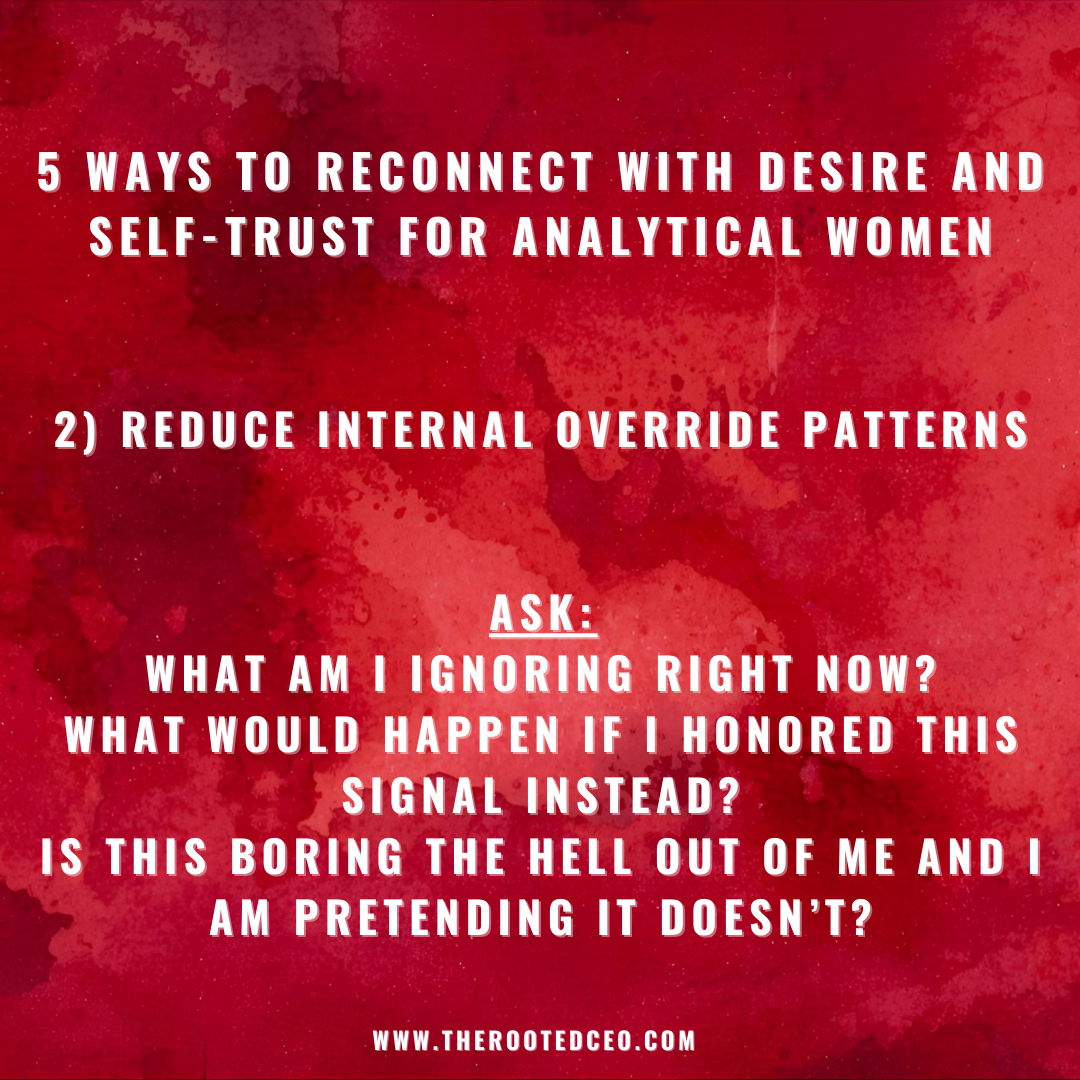
2. Reduce internal override patterns
Analytical women often override signals like fatigue, boredom, or hesitation. Practice pausing before overriding.
Ask:
What am I ignoring right now?
What would happen if I honored this signal instead?
Is this boring the hell out of me and I am pretending it doesn’t? (This has been my go-to question and it tells a lot.)
Even small adjustments rebuild trust and helps with rewiring daily habits and how you are showing up.
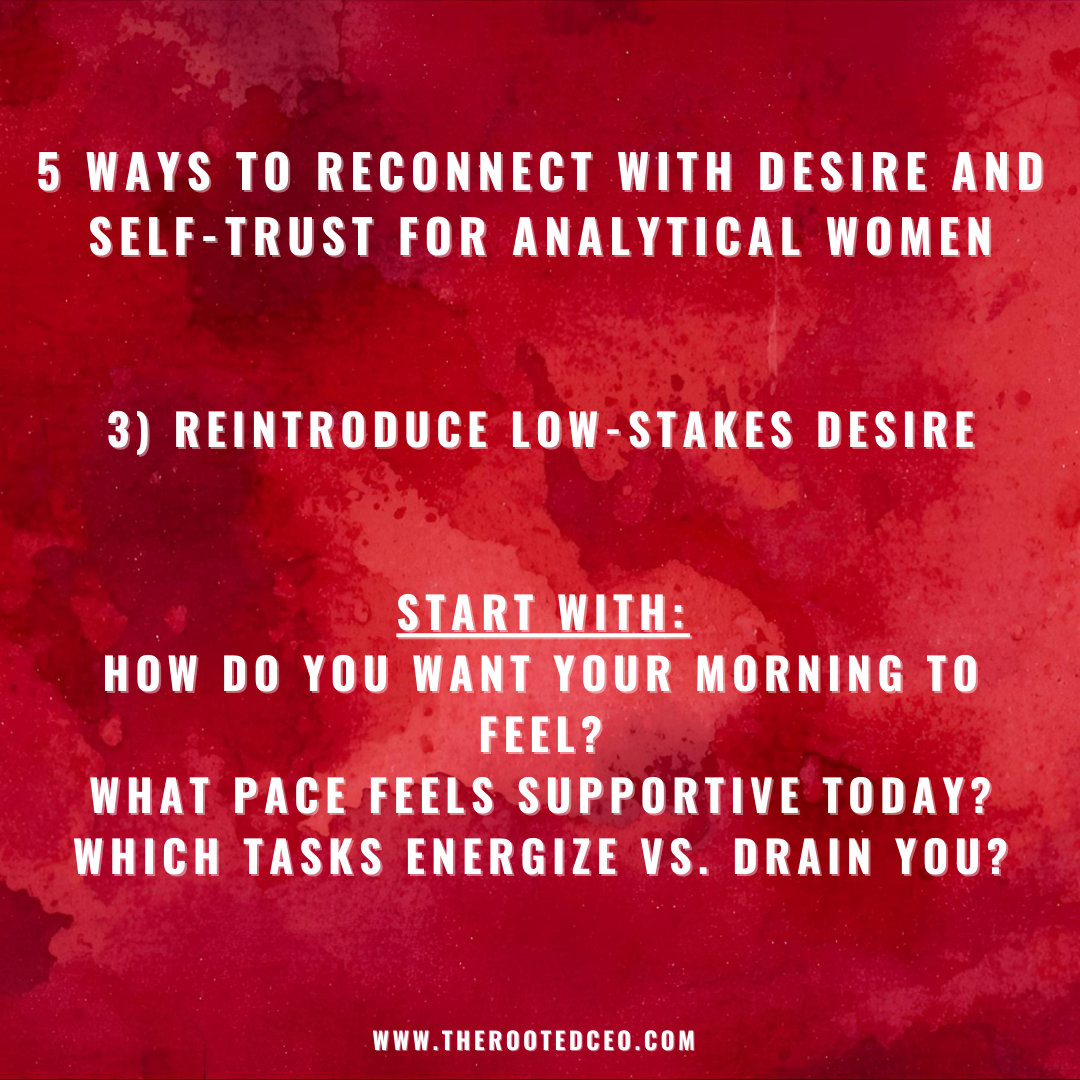
3. Reintroduce low-stakes desire
Desire returns more easily when nothing depends on it. Start with neutral preferences such as:
How do you want your morning to feel?
What pace feels supportive today?
Which tasks energize versus drain you? If it drains you, can you delegate it out?
Low pressure choices retrain the nervous system to respond honestly.
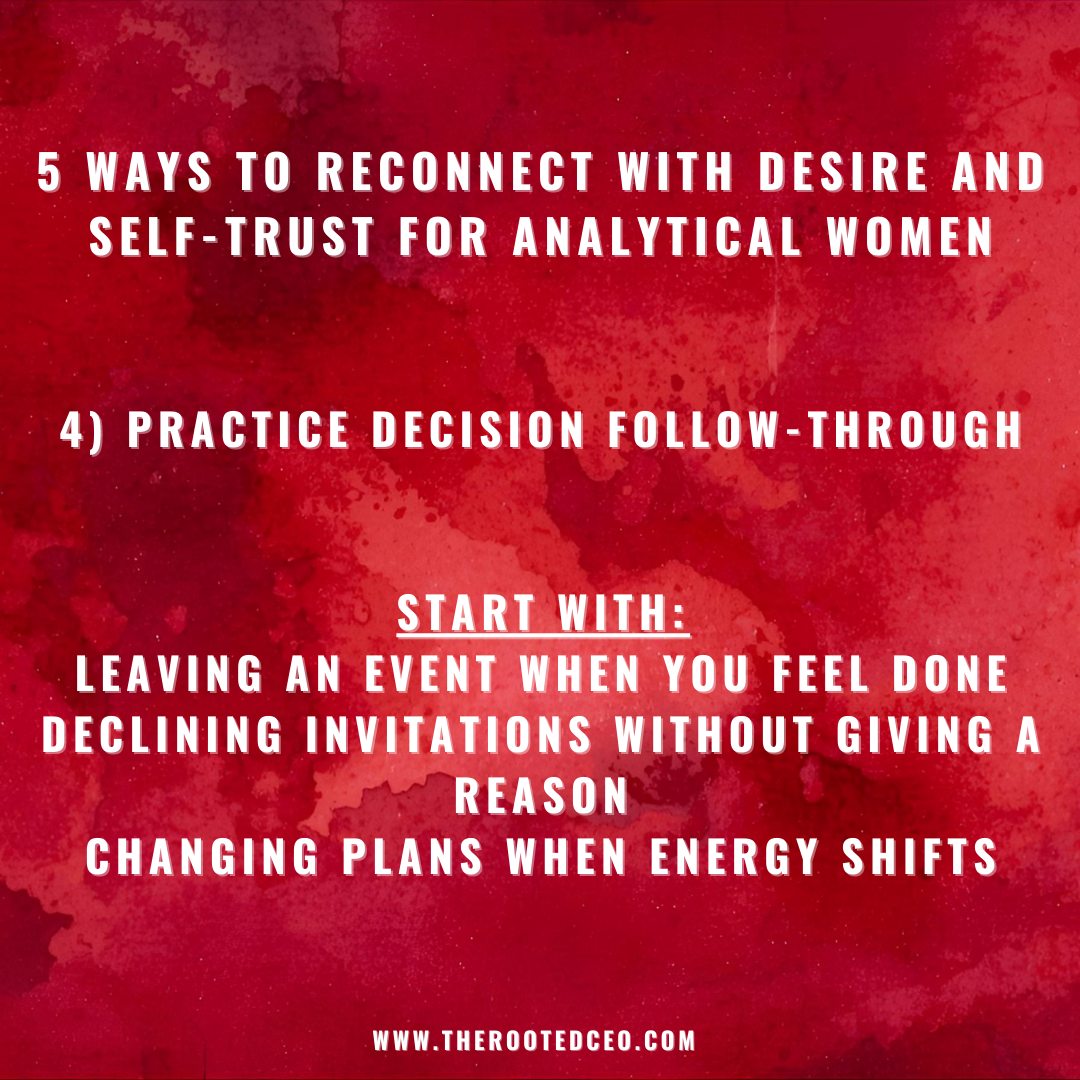
4. Practice decision follow-through
Self-trust grows when internal signals lead to consistent action. This does not always require big, dramatic decisions.
Examples:
Leaving a meeting when you feel done
Declining invitations without justification
Changing plans when energy shifts
Following through with what you truly want to do builds credibility with yourself.
5. Allow desire to evolve slowly
Desire is not always dramatic. It often returns quietly as:
Increased clarity
More nuanced preferences
Reduced urgency to decide quickly
Comfort with ambiguity
Progress may feel subtle but is cumulative. Think of how a snow ball grows as it rolls down a hill, it ends a lot larger than what it started with. Let your desire be a snowball.
How Long Reconnection Typically Takes
Rebuilding desire and self-trust is not a quick fix. Most women notice changes in phases:
Early awareness within weeks
Increased emotional range over months
Deeper trust with consistent practice
There is no correct timeline. The goal is not intensity but reliability. If you don’t notice or see any changes in six months, I would suggest reviewing it and see where you can make a tweak to do something different.
Common Mistakes That Delay Reconnection
Forcing emotional breakthroughs
Comparing yourself to more expressive people
Expecting clarity before taking action
Treating desire as something to optimize
Abandoning logic instead of integrating it
Desire works best when logic supports it rather than competes with it.
Final Thoughts
Analytical women do not lose desire because they are broken or disconnected from themselves. They lose it because their systems are efficient, protective, and deeply practiced.
Reconnection does not require becoming a different person. It requires restoring communication between logic and internal signals which takes a different approach than what you typically do when operating in your logic side 99% of the time.
When desire and self-trust return, decisions feel lighter. Boundaries strengthen. Life regains dimension without chaos.
People will notice that something is different about you and you will start to see it in photos of yourself of the spark being back in your eyes. That balance is not accidental. It is built.
About the Author
Megan Ellis is a consultant, strategist, and writer with over a decade of experience working with high-functioning professionals in high-pressure environments.
After spending years advising organizations on complex systems, risk management, and long-term strategy, Megan began writing about emotional reconnection for analytical women navigating life transitions such as divorce, identity shifts, and burnout.
Her work focuses on practical emotional frameworks that respect intelligence, autonomy, and real-world constraints. She writes for women who are capable, responsible, and outwardly successful, yet quietly disconnected from their inner world.
Through her writing, Megan helps women rebuild emotional connection in ways that feel grounded, sustainable, and self-trusting rather than performative or prescriptive.