Winter Reading and the Quiet Return to Emotional Availability in December

How December Books Softened My Beliefs About Love
December always feels like a threshold month to me. Not an ending exactly, and not yet a beginning, but a narrow bridge between who I have been and who I am quietly becoming. It is the one month of the year where time seems to hold its breath. The calendar insists on closure, but emotionally, everything feels suspended. Nothing is fully resolved. Nothing is fully new. There is simply the pause as you slide into the new year energy.
This past December, I noticed something subtle shifting in the way I moved through my days. I was still capable. Still responsible. Still showing up where I was needed. But underneath that, there was a softer awareness forming. A sense that I did not want to muscle my way into the next year. I wanted to arrive gently.
Without consciously deciding to, I stopped reaching for books that promised clarity, strategy, or transformation. I did not want to fix myself. I did not want to analyze my patterns or optimize my habits. What I wanted, though I would not have said it out loud yet, was permission to feel again without needing to do anything with those feelings.
So I read differently. More choosing what caught my attention and felt good vs. following a list of what I should be reading.
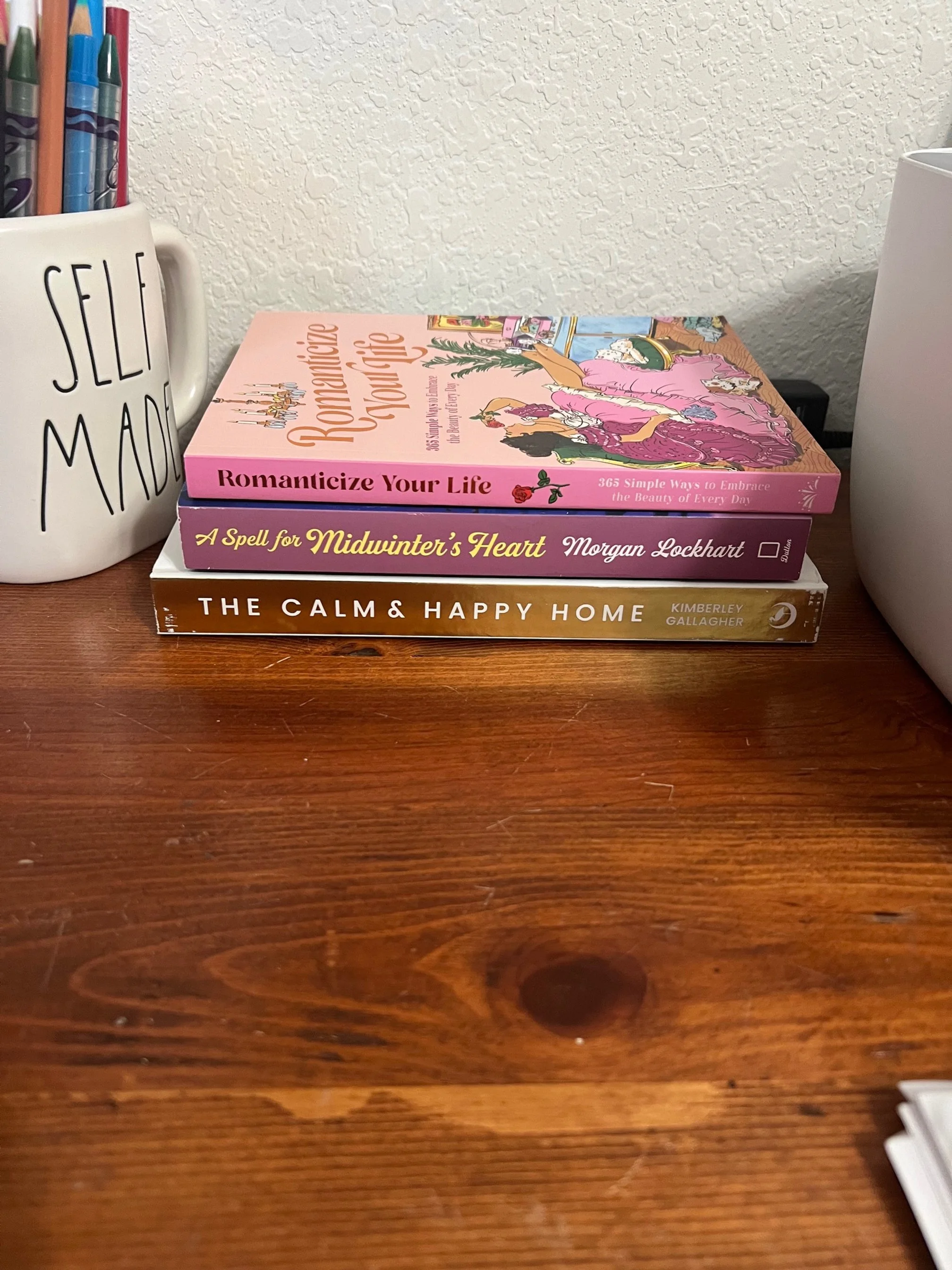
In the evenings, when the light faded earlier than I expected, I let myself slow down with Romanticize Your Life. The title itself could easily be misunderstood. Romanticizing life can sound like a demand to curate beauty, to turn existence into a performance. But that was not how the book met me at all. What it offered instead was a return to attention. To noticing. To allowing moments to matter even when no one else would ever see them.
I realized how practiced I had become at moving quickly through my own life. Even when there was nothing urgent, I stayed in a state of forward motion. Finish this. Get through that. Prepare for what comes next. Reading this book felt like being gently asked a question I had not considered in a long time. What if nothing needs to be earned right now? What if presence is enough?
Winter makes that question harder to ignore. The world outside goes quiet. Trees stand bare without apology. There is no pressure to bloom. No expectation of output. Just endurance and rest and trust that something is happening beneath the surface, even if it cannot yet be seen. That kind of season reveals how uncomfortable we are with stillness. It reveals how quickly we try to fill silence with distraction. Honestly, it can be extremely jarring when you realize that you cannot sit and just be without reaching for your phone to scroll through social media to see what everyone else is doing compared to slowing down to watch the world go by.
I did not read Romanticize Your Life straight through. I let it sit on my coffee table and returned to it when something in me needed to remember that my days are not a means to an end. That they are, in fact, the point. That attention itself is a form of devotion.
Around the same time, I began reading A Spell for Midwinter’s Heart. This was a book I picked up from a local book store a while back during a different book release event and I just hadn’t gotten to it yet. It felt more like something that waited until I was ready. Winter has its own emotional gravity. It pulls old feelings up from the depths, not dramatically, but persistently. Grief that has softened but never left. Longing that no longer hurts sharply but still hums quietly in the background. Memories that arrive unannounced, attached to smells or songs or the way the light falls at a certain hour.
This book did not try to resolve any of that. It did not suggest healing as an outcome. Instead, it offered companionship. Language for feelings that are difficult to articulate without flattening them. Reading it felt like sitting beside a fire with someone who understands that some emotions do not need solutions. They need witnesses.
There is something profoundly reassuring about that, especially for women who are used to being the strong one. Emotional unavailability does not always look like coldness. Sometimes it looks like self containment taken too far. Like learning how to hold everything on your own so well that you forget what it feels like to be held.
Midwinter has a way of revealing where we have over learned that skill.
As the days grew shorter, I noticed my emotional landscape changing. Not dramatically, but noticeably. I was less interested in explaining myself. Less interested in narrating my growth. More interested in simply letting myself feel what was present without rushing to define it. This felt like a quiet kind of ninth house work. Not the grand philosophical searching we often associate with that house, but belief softening at the most personal level.
Beliefs about what love requires. Beliefs about safety. Beliefs about how much tenderness is allowed.
I had not realized how many of those beliefs had hardened over time for me, not because I wanted them to, but because life demanded resilience. Winter did not challenge those beliefs directly. It simply offered me a different rhythm, one where hardness felt out of place.
At home, something similar was happening. After reading The Calm and Happy Home, I became more attuned to the way my space held me. Not in an aspirational way, and not as another project to manage, but as an extension of my emotional life. Winter collapses the distance between inner and outer worlds. When we spend more time inside, our surroundings matter differently. They stop being background and start becoming companions.
I noticed where my home supported ease and where it quietly asked me to brace myself. Lighting that was too harsh in the evenings. Clutter piling up in certain areas. Corners that felt neglected. Spaces that functioned but did not comfort. Making small adjustments felt like a form of care that did not require justification. A softer lamp. A chair placed where I could watch the light change. Blankets that invited me to rest rather than scroll.
This kind of attention is deeply emotional, even though it appears practical. It is a way of saying to yourself, you are allowed to feel safe here. You are allowed to rest without explanation. You are allowed to be gentle with yourself even when nothing is wrong.
For someone who has lived in a state of readiness for a long time, that is no small thing.
The novels I chose that month surprised me too. Christmas on Fifth Avenue, A Copenhagen Snowmance, It’s Beginning to Look a Lot Like Christmas. On the surface, these stories are light. Seasonal. Comforting. But beneath that, they carry something quietly subversive. They center warmth, connection, and possibility without cynicism. They allow romance to be tender rather than dramatic. They let belonging arrive without requiring grand gestures or personal reinvention.
I realized how rarely I let myself consume stories like that anymore. Somewhere along the way, I had decided that hope needed to be earned, that softness had to be justified, that romance was either naive or complicated. These books did not argue with those beliefs. They simply offered an alternative vision. One where connection unfolds gently. One where timing matters. One where people meet each other not at their most impressive, but at their most human.
That matters more than we realize.
Stories shape belief, especially the quiet ones we absorb without thinking. When we only engage with narratives that emphasize struggle, growth through pain, or love as something hard won, we internalize those frameworks. Winter reading, at least for me, softened that internal narrative. It reminded me that ease is not a moral failure. That warmth does not negate depth. That joy does not need to be provisional.
This is where I could feel the rumblings of my emotional availability start to roll over like a bear moving around in hibernation of stretching and getting ready to come out into the world; but feeling that it isn’t quite time yet. The beliefs we carry about what life is allowed to feel like. About what kind of love is realistic. About whether comfort is something we can trust. December did not ask me to replace those beliefs. It asked me to loosen my grip on them.
There is something about winter that invites integration rather than expansion. It is not the season for chasing new ideas. It is the season for letting what you already know settle into your body. For allowing experiences from the past year to reorganize themselves quietly. For noticing what no longer fits without needing to announce it.
I felt that happening as the year closed. Less urgency. Less need to declare intention. More willingness to stay with uncertainty without interpreting it as failure. Emotional availability, I realized, is not about becoming more expressive or more vulnerable in a performative sense. It is about being present enough with yourself that you can be present with someone else when the moment arrives.
That presence requires softness.
Softness toward your own history. Toward the parts of you that learned to protect themselves for good reason. Toward the longings that did not disappear just because you became capable of surviving without them. Winter does not demand that you act on those longings. It simply asks that you acknowledge them.
As December turned toward its end, I did not feel resolved. I felt integrated. The books I read did not give me answers. They gave me a different posture. A way of standing in my life that felt less defensive and more receptive. Less focused on outcome and more attuned to experience.
That feels like the real work of this season. Not planning who you will become next, but making peace with who you have already been. Letting the year settle into your bones. Trusting that clarity will come when the light returns, and that for now, it is enough to tend the quiet hearth of your inner life.
I carried that softness with me into the new year. Not as a resolution, but as a companion. A reminder that emotional availability is not something you force. It is something you allow, slowly, as you remember that your heart was never meant to be armored forever.